Friday, February 21, 2014

Julia Bracken Wendt: Sculptor with Feminist Sensibilities

1871-1942


Notable American sculptor, Julia Bracken Wendt, was one of the few female artists ranked equally with their male counterparts during the first two decades of the Twentieth Century. Wendt was born in Apple River, Illinois, the twelfth of thirteen children in an Irish Catholic family. Following the death of her mother when she was only nine years old, she felt adrift within the family, so she ran away from home at age thirteen and was on her own.
By the time she was sixteen years old, she found work as a domestic servant for a woman who recognized her talent and drive, and paid to enroll her in the Chicago Art Institute. She studied with Lorado Taft for six years and by 1887, she became his studio and teaching assistant. Wendt earned an excellent reputation over the course of her career and was referred to as the "foremost woman sculptor of the west...whether men or women."

Julia Bracken Wendt
Music
ca. 1915
Bronze
8 7/8 x 7 1/4 inches
In 1893, during the Columbian Exposition she was one of several women sculptors nicknamed the "White Rabbits" who helped to produce some of the architectural sculpture that graced the exposition buildings. In addition, she was awarded a commission to produce Illinois Welcoming the Nations for the Fair. The work was later cast in bronze and unveiled at the Illinois State Capitol.

Wendt, who sculpted portraits, fountains, and bas-relief medallions in bronze, was not a modernist in artistic style, but she proclaimed her feminist sensibilities in her contribution to the Panama Pacific International Exposition held in San Francisco in 1915, and in San Diego in 1916. Wendt proved to be an exceptional artist and was the only woman to win a gold medal for her work.

It was Wendt who originated the idea of placing the sculptured figures that typified the attributes of woman in the Women's building of the exposition, and it was she who carried the project through to the finish. Wendt not only created the figures, she completed the work on her own. She supervised the installation and raised the statues to their pedestals when the workmen were confounded with the process. Wendt demonstrated her executive ability, creativity, and problem-solving skills with thoughtfulness and imagination. Sculpture is a demanding, physical, endeavor that requires much more strength than that of painting on paper or canvas.

After successfully pursuing her career for a number of years, Wendt married painter William Wendt and moved to Los Angeles, California, in 1906, where they became a highly prominent artist couple. Wendt taught at the Otis Art Institute and became a member of the National Sculpture Society.
Julia Bracken Wendt
National Women's Trade Union Seal
Pen and ink drawing on board
Manuscript Division
Gift of the National Women's Trade Union League
 
In 1911, she began a commission of an eleven-foot high, three-figure allegory group for the rotunda of the Los Angeles County Museum. Wendt chose to represent History, Science, and Art as draped goddesses with uplifted hands holding electrically lit globes.

 NHM Rotunda: Julia Bracken Wendt -- Three Muses (Science, History, and Art)
Julia Bracken Wendt
Three Muses (Science, History, and Art)
ca. 1911
Natural History Museum Rotunda


In 1913, she was commissioned by the government of Canada to create a King Edward Peace Memorial, which was installed at Saskatoon.


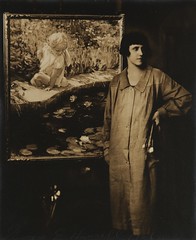
Julia Bracken Wendt's Studio
ca. 1915
Photographer unknown
Handwritten caption: CHRISTMAS GREETING FROM JULIA BRACKEN WENDT TO CHAS. F. LUMMIS

 
Julia and William had no children. Julia Bracken Wendt passed away in 1942

                                                   Julia and William in their Laguna Beach Studio


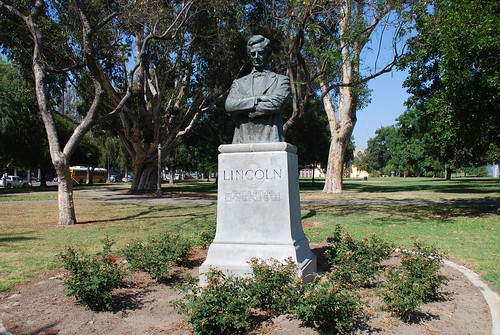
Lincoln the Lawyer
Julia Bracken Wendt
Lincoln the Lawyer
ca. 1926
Lincoln Park, Los Angeles, CA


Exhibitions: 
World's Columbian Exposition, Chicago, 1893
Annual Exhibition, Palette Club, AIC, 1895
Annual Exhibition of Works by Chicago Artists, AIC, 1899-1910 (9 times)
St Louis/Louisiana Purchase Exposition, 1904
Chicago Municipal League, 1905
Pan-California Expo, San Diego (CA), 1915
California Art Club, 1918
Solo exhibits with husband, AIC, 1909-21
National Sculpture Society, 1929
National Sculpture Society, Los Angeles (CA) Museum
Awards: 
Commission, "Illinois Welcoming the Nations" for Columbian Exposition, Chicago, 1892
Commission, Exposition Park, Los Angeles (CA). Commission, Battle Monument, Missionary Ridge (TN)
Sculpture Prize, Chicago, 1898
Municipal Art League Prize, Chicago, 1905
Gold Medal, Pan-California Expo, San Diego (CA), 1915
Harrison Prize, Los Angeles (CA), 1918
Memberships: 
Chicago Society of Artists
Chicago Municipal Art League
Society of Western Artists
Los Angeles (CA) Fine Art Association
California Art Club, Los Angeles
NAC
Three Arts Club of Los Angeles (CA)
Laguna Beach Art Association
Collections: 
Los Angeles (CA) County Museum of Art       
____________________________________________________________
Sources:
Waggoner, "The art of J.B. Wendt," Los Angeles Herald Sunday Magazine, March 27, 1910, p.1.
Edenhurst Gallery, Julia Bracken Wendt, http://www.edenhurstgallery.com/painting.php?id=1929, retrieved 2/21/14
Illinois Women Artist Project, Julia Bracken Wendt, http://iwa.bradley.edu/artists/JuliaWendt, retrieved 2/21/14
American Treasures of the Library of Congress, http://www.loc.gov/exhibits/treasures/trm167.html, retrieved 2/21/14
Yesterday and Tomorrow: California Women Artists, Sylvia Moore, ed. Midmarch Arts Press, New York, 1989.

Tuesday, February 18, 2014

Jessiejo Eckford: Dallas Native and Artist of Western Scenes

JessieJo Eckford
Mosquito Fleet Galveston
ca. 1933
Woodblock print
Painter and woodcut artist Jessiejo Eckford was born November 25, 1895 in Dallas, Texas. Her unusual name is a combination of her mother's; Jessie, and her father's; Joseph, a local judge. She lived her entire, but relatively brief life of only forty-six years in Dallas, but traveled extensively to paint around the state of Texas. In addition, she created art in New Mexico; Mexico; Massachusetts; the Ozarks; New York; and internationally when she toured the world in the mid-1920s.

Eckford began her art training in Dallas at the Aunspaugh Art School and later studied with Hale W. Bolton and Frank Reaugh in Texas. She also trained in Los Angeles and in Gloucester, Massachusetts. In 1929, Eckford won $250 in the Edgar B. Davis Texas Wildflower Competition with her painting, Prickly Pear.


Texas:Early Texas Art - Regionalists, JESSIEJO (JESSIE JO) ECKFORD (American, 1895-1941). Birches onLake Carlos, 1929. Oil on panel. 10 x 13-1/2 inches (25.4...
JessieJo Eckford
Birches on Lake Carlos
ca. 1929
 Oil on panel
 10 x 13-1/2 inches 
Prior to 1930, Eckford painted primarily in oil, but after that year, she gravitated towards working with wood blocks and watercolors.

 
JessieJo Eckford
Monterey, Mexico
ca. 1920s
Watercolor on paper
 
In 1934, she had a one-person exhibition in Dallas at the Joseph Sartor Galleries. The names of her works reflect her interest in western scenes, particularly of Texas such as Bluebonnets; Garza Prairie; and Afternoon, West Texas. There was a certain element of expressive, romantic fantasy in her buildings and landscapes.

JessieJo Eckford
Uncle Ben
ca. 1934
  woodcut on paper
6 x 8 inches 
Group shows include the California Palace of the Legion of Honor, San Francisco; Print Club of Albany, New York; Smithsonian Institution, Washington, D.C.; International Printmakers, Los Angeles, California; Washington Watercolor Club, Washington, D.C.; American Watercolor Society, New York City; Midwestern Artists, Kansas City, Missouri; and the Southern States Art League.

Eckford also exhibited in many Texas venues: the Witte Memorial Museum, San Antonio; Centennial Exposition, Dallas; Texas Fine Art Association, Austin; San Antonio Competitive Exhibition; Fort Worth Museum of Art; Dallas State Fair; and Dallas Women's Forum.

Jessiejo Eckford died in Dallas on December 5, 1941 after a long illness.

Eckford's work is in the collections of the Witte Memorial Museum, and the Elisbet Ney Museum, Austin, and the National Gallery of Art in Washington, D.C.


____________________________________________________________
Sources
Phil Kovinick and Marian Yoshiki Kovinick, An Encyclopedia of Women Artists of the American West, University of Texas Press, Austin.
University of North Texas Digital Library, Jess Edith Self, History of the Growth of Art Interest in Texas in the Last Two Decades. http://digital.library.unt.edu/ark:/67531/metadc75321/m1/42/, (retrieved February 17, 2014).


Tuesday, February 4, 2014

Donna Noreen Schuster: Interested in Everything

Donna Noreen Schuster
In the Garden
ca. N.D.


As the daughter of a Milwaukee cigar manufacturer, Donna Schuster had the family resources to study with the best painters in America. She attended the Art Institute of Chicago and, after graduation, the Boston Museum of Fine arts school. Schuster continued her education in art by accompanying noted artist William Merritt Chase on a painting tour of Belgium in the summer of 1912. As a result of her study, her work was strongly influenced by the Boston School and Impressionism as tempered by Chase.

Donna Noreen Schuster
Sleep
ca. N.D.
Upon her return to the United States, Schuster moved to California in 1913 where she once again studied with Chase in Carmel. She stayed in San Francisco during the fall of 1914 where she worked on a series of watercolor sketches of the construction of the Panama-Pacific International Exposition. She earned a silver medal for watercolor there, which was shown at the Los Angeles Museum of History, Science and Art in 1914.

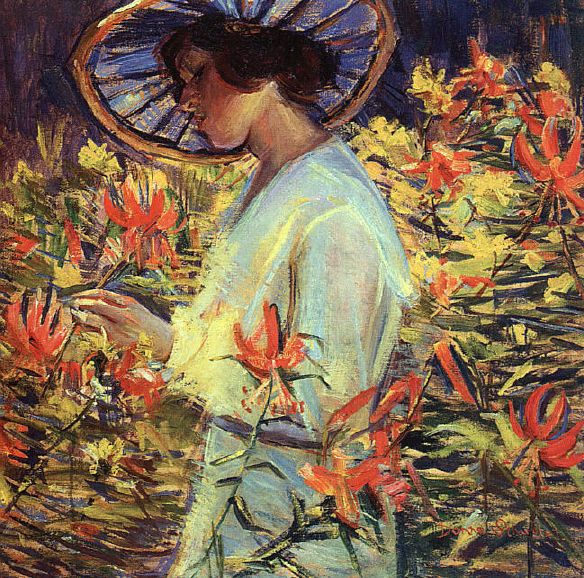
Donna Noreen Schuster
Tiger Lilies
ca. N.D.
During the 1920s and 1930s Schuster taught at the Otis Art Institute and was an organizer in the creation of several artists’ clubs and was a founder of The California Watercolor Society and a group that later became Women Painters of the West. Her subject matter included harbor scenes, landscapes, figure studies, and showed Cezanne's influence in her studies of water lilies in both oil and watercolor.  Indeed, her early works show the influence of Monet and Chase; however, after she studied with Stanton MacDonald-Wright, she later experimented with various modern idioms including Cubism and Abstract Expressionism.

Donna Noreen Schuster
Little Mother
ca. N.D.

Summers found Schuster at her small home in Laguna Beach where she spent her time painting and helped to establish the Laguna Beach Art Association. Her paintings recorded many areas of the Southern California landscape before it became the congested metropolis that it is, unfortunately, today.

During her early years, Schuster's art was exhibited at the Los Angeles County Museum of Art in the years 1914, 1917, 1920, 1927 and 1929. Later, in the 1930s, she had shows at the San Francisco Art Association, the New York Academy of Fine Art and the New York Water Color Society. In addition, Schuster exhibited with the California Watercolor Society from 1921 until the mid 1940's.

Tragically, in 1953, Schuster died, trapped inside her home as it was destroyed in a brush-fire.

Exhibitions:
Minnesota Artists, 1913 (gold medal); Blanchard Gallery (LA), 1914; LACMA, 1914, 1917, 1920, 1927, 1929; PPIE, 1915 (silver medal); Panama-Calif. Int'l Expo (San Diego), 1915 (silver medal); NW Exhibition (St Paul, MN), 1915 (silver medal); Calif. Art Club, 1915-33; SFAA, 1916; Woman’s Club (Hollywood), 1920, 1927; Calif. WC Society, 1921-42; Laguna Beach AA, 1924-30; LA County Fair, 1924, 1927; Friday Morning Club (LA), 1925; Ainslie Gallery (LA), 1926; Calif. State Fair, 1926; Bernay Gallery (LA), 1926; Artland Club (LA), 1927; Pasadena Art Inst., 1927; Ebell Club (LA), 1930; Artist’s Fiesta (LA), 1931; Palos Verdes Library, 1933; GGIE, 1939; Festival of Arts (Laguna Beach), 1949.

Collections:
LACMA; Downey (CA) Museum; Oakland Museum; Fleischer Museum (Scottsdale); Irvine (CA) Museum; Orange County (CA) Museum.

________________________________________________________
Sources
Edan Hughes, "Artists in California, 1786-1940"
American Art Annual 1913-33; Who's Who in American Art 1936-56; Southern California Artists (Nancy Moure); California Impressionism (Wm. Gerdts & Will South); Plein Air Painters (Ruth Westphal); Art of California, May 1991; Art in California (R. L. Bernier, 1916); Los Angeles Times, 1-3-1954 (obituary).


Friday, January 24, 2014

Culture, Time, and Passion...The Fibres of Art

WCCA Logo


Calling all Artists and Art Historians!


Warnborough College (my Alma mater) is holding its second annual Conference on the Arts in Canterbury, England this summer, beginning on the evening of August 18 through August 21, 2014. If you are able to attend, it promises to be a wonderful opportunity to meet and to collaborate with fellow art "folk."

Artists in all media, academics, archivists, historians, curators, guides, students, researchers, curriculum planners, policy makers, photographers, and professionals in the fields of media, education, arts, music, humanities, science, and social sciences, are encouraged to attend.

I am the Director of Round Table Discussions-please send me an abstract of your proposal for your paper. Hopefully, you will then present at the conference. I'll look for your abstracts at victoria@warnborough.edu

All additional information for the conference and submissions can be found at http://warnborough.org/

Join us for this exciting event!


Monday, January 13, 2014

Ila Mae McAfee: Taos Painter

Ila McAfee Oil Painting A Chain Reaction Trouble on the Trail
Ila Mae McAfee
A Chain Reaction: Trouble on the Trail
Oil on Canvas
ca. N.D.
 36 x 48 inches 
Ila Mae McAfee was born in 1897, in the small ranching community of Sargents, in southwestern Colorado near Gunnison. Her artistic interest began early and centered upon horses, which she would draw as a child. After she graduated from Gunnison High School in 1916, McAfee spent time in Los Angeles at the West Lake School of Art and the Haz Art School (1917-1918).
McAfee received her Bachelor's degree in art from Western State College, but her formal art education was at the aforementioned Haz Studio School in Los Angeles and at the Art Institute of Chicago. She decided to study under muralist James E. McBurney from whom she had taken courses in Chicago. McBurney hired McAfee as his assistant until 1924, after which she traveled to New York to study at the National Academy of Design and the Art Students League. While in New York, McAfee worked as an illustrator and a painter of miniatures and did illustrations for Blue Book, Ranch Romances and other magazines.

Ila Mae McAfee
Entrance to Spring
ca. N.D.
         Oil on canvas board
 16 x 20 inches
In 1926, McAfee returned to Colorado and married Elmer Page Turner, an artist she had met on her parent's Colorado ranch. She and Turner moved to Taos in 1928 to be a part of the burgeoning art movement of the region. There, they built White Horse Studio, which would serve as their studio and home until 1993.


Ila McAfee
New Mexico Desert
ca. 1930s,
Oil on board,
32 x 65 inches
 
 
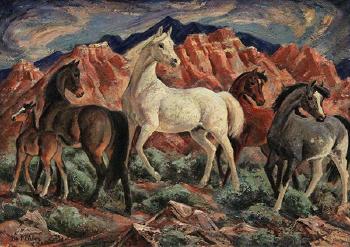
Ila McAfee
Alert
ca. N. D.
Oil on canvas
20.25 x 28.25 inches
 
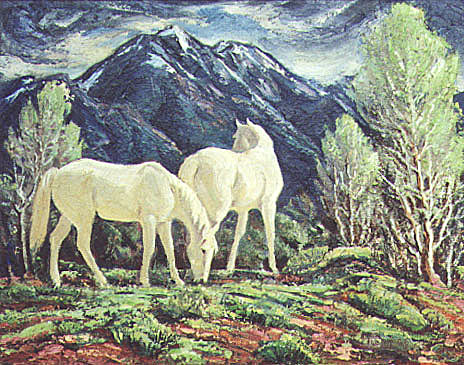
In Taos, McAfee painted landscapes and figures, but her specialty remained animals, specifically horses. She also worked as an illustrator of children's books. She worked on a number of murals, as well, though she was most famous during her lifetime for something entirely unrelated to her art; she owned a series of cats, all named Sanka, to whom she taught as many as seventy five tricks each.

 
Ila Mae McAfee
  Red Willows
    ca. N.D.
  Oil on canvas
  18 x 20 inches

In addition to over a thousand easel paintings, which are represented in numerous public and private collections, McAfee’s murals were placed in the post offices of Clifton, Texas, Cordell and Edmond, Oklahoma and Gunnison, Colorado, as well as in the public library of Greeley, Colorado. She was a  friend of the noted Western art collector, Lutcher Stark and painted fifteen portraits of Lutcher’s longhorns at "Shangri-La." She also received every award that could be won at the New Mexico State Fair professional juried show.
Ila McAfee Oil Painting Woman with Blanket
Ila Mae McAfee
Woman with Blanket
Oil on Panel
ca. 1950
8 x 10 inches


Ila McAfee Painting Horses in Rhythm
Ila Mae McAfee
Horses in Rhythm
Watercolor
ca. 1971
5  x 4 inches 

In Taos, she became known for her pueblo paintings and her depictions of horses and other animals as well as Native Americans, ranch scenes, and landscapes. During an interview for Southwestern Art 20, Rita Simmons asked about her first impressions of Taos. McAfee said, "[Taos] was so different then, the village was small and the Indians remained uninfluenced by the invaders. Once I asked one of them, "What did you call this country before the Europeans came?" 'Ours,' he told me."

In 1981, she was voted Taos Artist of the Year.  In addition, she worked as a WPA artist, completing a number of commissions for post office locations such as Edmond, Oklahoma, and Clifton, Texas.

Ila Mae McAfee lived a long, productive life that spanned nearly the entire twentieth century. She moved to Pueblo, Colorado in 1993, where she died two years later, after leaving her beloved adobe home in Taos, New Mexico.


_______________________________
Sources:
Taos and Santa Fe Painters, http://www.ilamcafeepaintings.com/, Retrieved January 10, 2014
http://www.askart.com/askart/m/ila_mae_mcafee/ila_mae_mcafee.aspx, Retrieved January 10, 2014
Kovinick, Phil and Marian Yoshiki-Kovinik, An Encyclopedia of Women Artists of the American West, (Austin: University of Texas Press), 1998, 208.
Rita Simmons, "Ila McAfee," Southwestern Art 20 (September 1990): 100.

Wednesday, December 18, 2013

Margrethe Mather: Modernist Photographer

EW_MMather_1914
Edward Weston, Margrethe Mather,
 ca. 1914, gelatin silver print
Collection Center for Creative Photography, University of Arizona, Tucson AZ
On March fourth of this year, Photography News wrote this about Margrethe Mather on the 125th anniversary of her birth in Los Angeles. " . . . . Margrethe Mather was a photographer who --through her exploration of light and form-- helped to transform photography into a modern art."
 
Despite her marvelous body of work, Margrethe Mather remains an enigmatic figure, best known for her association with Edward Weston . . . . However, many consider Mather to have been Weston's mentor and teacher. She shared with him her intuitive eye for composition and her innate sense of artistic style, "teaching him how to edit an image to its very essence."

Imogen Cunningham, Edward Weston and Margrethe Mather 3, 1922
Imogen Cunningham
Margrethe Mather and Edward Weston
ca. 1922
Gelatin Silver Print
8 x 10 inches
Close companions for over a decade, Mather and photographer, Edward Weston, collaborated on many photographs. The photographers had a profound influence on each other and on the history of photography in the years just before and after the First World War, as photography swung back and forth between pictorialism and modernism. Mather, a photographer of considerable accomplishment who taught and learned from Weston, has unfortunately vanished into obscurity while his reputation has continued to flourish over time.

Collaboratively, Mather and Weston founded the Camera Pictorialists of Los Angeles in 1914 that became one of the most important camera clubs and exhibition venues in the country.

Lady in White
Margrethe Mather
Lady in White
ca. 1917
              Platinum print, 9 5/16 in. x 7 3/8 in.
 Collection SFMOMA
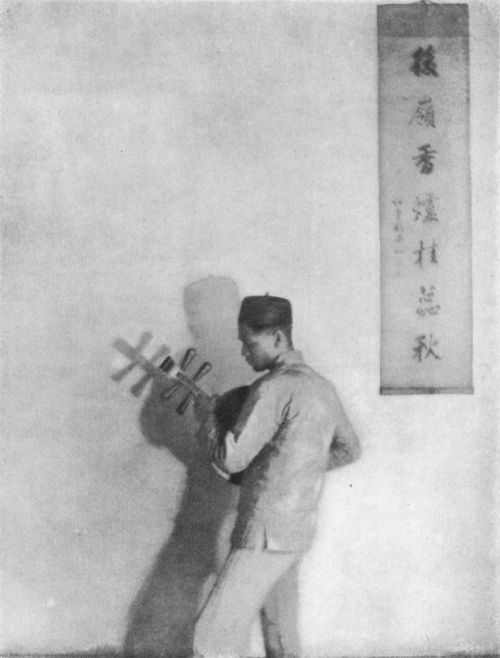
Mather's early work was in the Pictorialist style, beautifully photographed images, veiled in hazy, soft-focus effects, such as the above Lady in White, taken in 1917. Mather and Weston had begun to employ the distortion of shadows to intensify the drama of their images. In her 1918 photograph of a Chinese poet, Moon Kwan, Mather strategically placed the poet's figure and his shadow in broad spatial areas to produce spare, but arresting compositions, that were quite ahead of their time.
 
blue-voids:

Margrethe Mather - Player on the Yit-Kim, 1918
Margrethe Mather
Player on the Yit-Kim
ca. 1918
 
File:FlorenceDeshon.jpg
Margrethe Mather
Florence Deshon,(1894-1922) US motion picture actress.
ca. 1921
Bromide print, 9 1/2”x 7 1/2”. Paul J. Getty Museum, Los Angeles 
Margrethe Mather
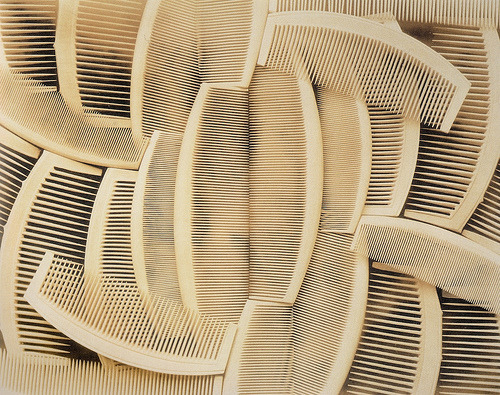
Japanese Combs
ca. 1931
 
Mather, an artistic and political rebel and a liberated sexual woman, helped to turn Weston's work in a more experimental direction by introducing him to her circle of free-thinking artists, actors and theater people, and political activists. Although Weston appreciated by Mather's intellectual curiosity, and for a time was passionately in love with her, he was also frustrated with her lack of dependability and unpredictable nature. In 1921, Weston embarked on an affair with the Italian-born actress photographer, Tina Modotti. When they departed for Mexico in 1923, Weston entrusted his Glendale studio to Mather's care, however by 1925, she lost interest in sustaining the business and drifted back to her bohemian haunts on Bunker Hill in downtown Los Angeles. Mather continued to shoot photographs sporadically until the mid-1930s, when she appears to have turned her back on photography altogether.

Mather's photographs were more experimental than those being produced by her contemporaries. Margrethe Mather died on December 25, 1952.

Her work is featured in the book, Margrethe Mather & Edward Weston: A Passionate Collaboration (W.W. Norton & Santa Barbara Museum of Art, 2001).
 
In the early 1950s, recalling the greatest influences on his career, Edward Weston declared that Margrethe Mather was "the first important person in my life."

________________________________________________
Sources
http://giam.typepad.com/analog_photography_at_its/2011/09/margrethe-mather-1885-1952.html, retrieved December 17, 2013.
Grace Glueck, Art In Review, Edward Weston and Margrethe Mather, A Passionate Collaboration, April 4, 2003, http://www.nytimes.com/2003/04/04/arts/art-in-review-edward-weston-and-margrethe-mather-a-passionate-collaboration.html, Retrieved December 17, 2013.
SFMOMA, http://www.sfmoma.org/explore/collection/artwork/12772, Retrieved December 18, 2013
Margrethe Mather and Edward Weston: A Passionate Collaboration, http://www.tfaoi.com/aa/3aa/3aa602.htm, Retrieved December 18, 2013

Thursday, December 5, 2013

Happy Birthday, Women Out West! Meet Ruth Peabody-Painter, Sculptor, and Educator

Thanks to all the readers of my blog-the first post was created one year ago on November 22, 2012. This has been an incredible journey of discovery. After I submitted my dissertation I thought, now what? I had been writing for two solid years, nearly every day, through weekends, holidays, vacations, and summers. The void after completing the program was immense, so I began to investigate other avenues in which to continue to grow.

I have learned so much from the research into the fifty female artists that have been profiled throughout this year, along with their remarkable lives and contributions both to society and to the art world. I have been influenced and inspired by them-talented women, all.


Ruth Peabody
Ruth Eaton Peabody
Laguna Beach Art Association Artist
(c) HurrellPhotos.com
Ruth Eaton Peabody was a painter who, along with her mother, artist Elanor Colburn, were California modernists in the early part of the twentieth century. Peabody was born in Highland Park, Illinois on March 30, 1893. She first studied sculpture at the Art Institute of Chicago and was taught to paint as a child by her mother. The two women moved to Laguna Beach, California in 1924 and became active in the local art scene where, in addition to painting, Ruth sculpted fountains and memorial plaques along with teaching art.
 
Ruth Peabody
Boy and Dog
Fountain
ca. 1935
Laguna Beach, California
In her early works, Peabody focused on the figure and on still lifes. The Cook Book combines both these subjects in a carefully constructed composition. The woman looks pensive, perhaps pondering what to make for dinner.
 
Ruth Peabody
The Cook Book Oil on canvas, 1925
32 x 40 inches
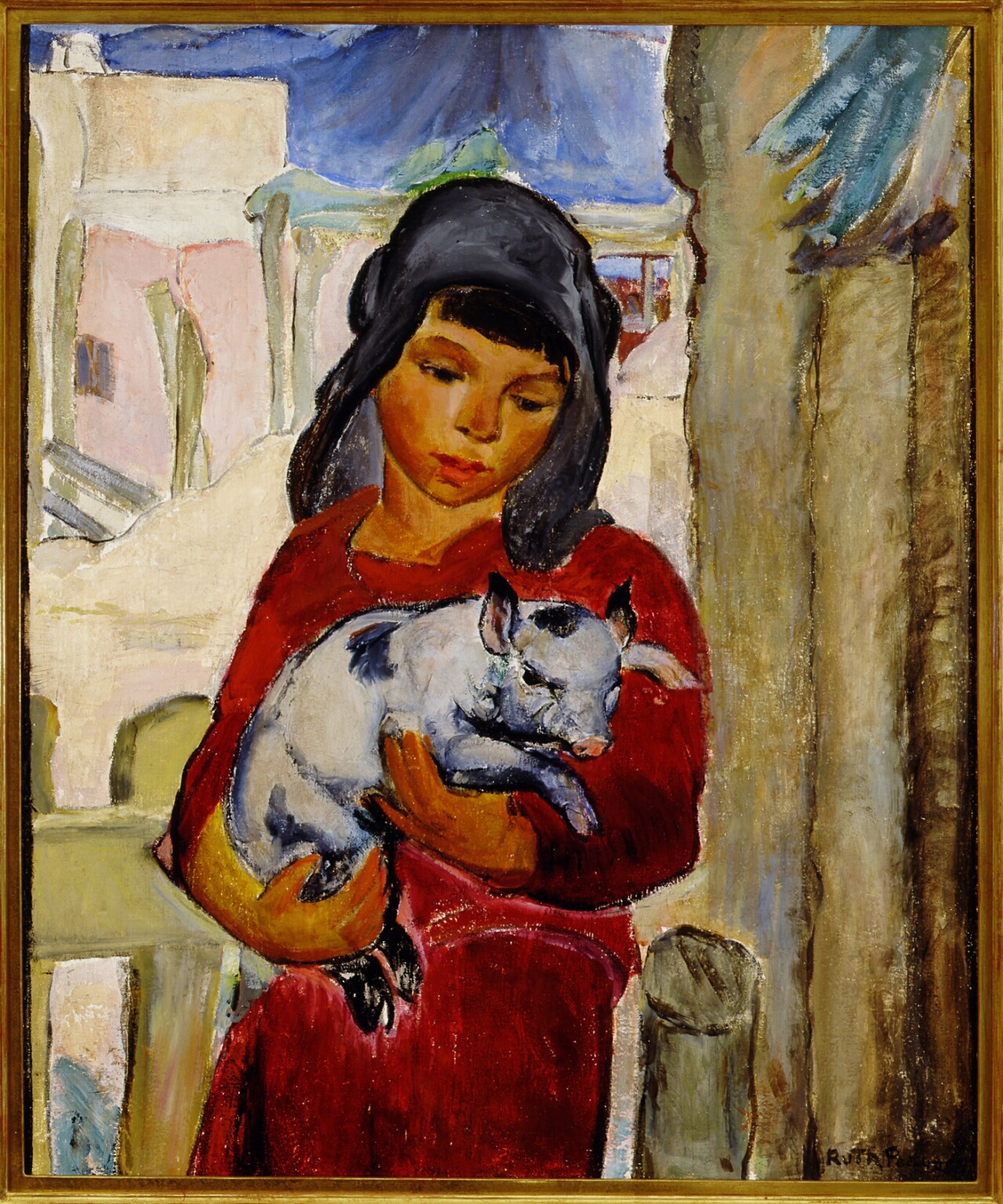
Little Pig in New Mexico is created in a post-Impressionist style of lively broad brushwork and strong colors. The painting was perhaps inspired by a trip to New Mexico to which Peabody and her mother took in early summer, 1930. (Note the pueblo in the background). In the 1930s, Taos, Santa Fe, and the Southwest in became popular destinations for artists that sought fresh subject matter and discovered sweeping new vistas.


Ruth Peabody
Little Pig in New Mexico
ca. 1931
Oil on canvas, 24 x 20 in.

For years, Peabody designed figural compositions that were much like her mother's style, but in the 1930s, she explored Dynamic Symmetry and Cubism and her work went beyond the objective to Constructivist compositions.


Ruth Peabody
Laguna Beach
ca, 1930s
25x 20 inches
Oil
 
Peabody was an active member in the Laguna Beach Art Association, the California Art Club, and the San Diego Art Guild.  She received dozens of awards in Southern California between the years 1926-1937. Ruth Peabody died in Laguna on October 22, 1966.

Peabody's exhibitions include the Panama Pacific International Exposition, 1915, Pennsylvania Academy of Fine Arts, 1931, Art Institute of Chicago;  Oakland Art Gallery, 1932, Golden Gate International Exposition, 1939, San Diego Fine Arts Gallery, 1939, California State Fairs.

Works are held in the San Diego Museum, drinking fountain opposite the  Laguna Beach Art Gallery, Laguna Beach Art Association (portrait medallion of Anna Hills), Laguna Beach Humane Society (fountains), Anaheim High School, Hoag Memorial Hospital, and in Newport Beach.
 
_________________________________________________
Sources
California Art: http://www.californiaart.com/artist-peabody.html, retrieved 12.3.13
The Redfern Gallery: http://www.redferngallery.com/artistbio.php?at=RuthPeabody, Retrieved 12.4.13
The Orange County Register, article: Where the Art Is: Laguna Beach's Public Art Tour Day to highlight works found throughout the city, http://www.ocregister.com/articles/art-24966-city-public.html
, Retrieved 12.4.13
Patricia Trenton, ed., Independent Spirits: Women Painters of the American West, 1890-1945 (Los Angeles: University of California Press, 1995), 100.