Monday, April 8, 2013

Women in the Western Art Scene: Part One

Marion Kavanaugh Wachtel
Long Lake, Sierra Nevada
 Oil on canvas
20 x 26 inches
ca.  n.d.
Collection of The Irvine Museum
          From the nineteenth century to the present day, the American West has been defined as the region west of the Mississippi to the Pacific Ocean. The West, however, is not simply a single region, but a set of values and mythologies, germane to the specific areas, and historical period of the United States. In this sense, there are multiple “Wests” that encompass a succession of frontiers, beginning in the northeast, and pushing progressively westward. Where do women fit in this saga of Western exploration amid the masculine narratives of conquest and domination that have come to represent the American West? Exploitation, and alteration of the West, was never part of women’s desires in facing frontier life. It is assumed that women wanted to provide for communal and spiritual needs by gardening, creating quilts, crafting pottery, or engaging in some form of traditional “women’s work.” While Western historians grapple with a 'new' historiography of the American West—rethinking and broadening its scope in terms of race, class, and gender—the production of art by Western women has all but been ignored. Nearly all the attention and focus of art in the West has been directed toward nineteenth-century artwork created by men, and towards the stereotypical imagery of the Old West, conveyed by their work. [1]
Nearly everyone has heard of western artists Frederick Remington, and Charles M. Russell, whose cowboy and Indian art defined the classical western art canon. How many of those same people, artists and non-artists alike, are aware that women artists also worked in what would come to be called the American West, and have done so for as long as humans have inhabited the terrain? Navajo women wove. Pueblo women made pottery. Pomo women shaped baskets. Between 1890 and 1945, women artists of all types worked in the West in great numbers, creating objects that were as extraordinarily abundant and diverse as to defy generalization. [2] 
Hopi woman weaving a basket.
Photographed by Henry Peabody

ca. 1900
Until the 19th century, the western United States and the California landscape had not been painted.  Foreign explorers of the Pacific Coast in the early 1800s brought artists to record both their discoveries and interesting sites along both coast and inland. Later, government surveys enlisted artists to record the geology and geography, vegetation and inhabitants of this westernmost region. There were not, however, any female Audubons, women explorers, or government survey teams. Even in the “wild” West, social restrictions prevented women from traveling alone, or with expeditions, into the wilderness, or to record the landscape. That was a male concern with which women were not encouraged to participate. [3] As women traveled west with their families, the bulk of their artistic narrative left behind were letters, diaries, cookbooks, crafts, and quilts. Yet, there were women painters working among the early settlers—and by the time the frontier closed in 1890, there were more than 1100 women artists and art teachers active in the west. [4] Although many of the paintings of these early artists are regarded more as historical documents, rather than works of art, they represent the beginning of a Western visual heritage.
The discussion of art in California, in particular, must address the differences between the Northern and Southern regions of the state, because each area is distinct geographically, climatically, and culturally. Although the north and south have no legal borders, for the purposes of this blog, Southern California refers to the lower third of the state, with its primary boundaries from south to north being: the cities of San Diego, Los Angeles, and Santa Barbara, (each founded during the Spanish period) Palm Springs, the Mojave desert, and the southern Sierra Mountains. Northern California encompasses the region beyond Santa Barbara including San Luis Obispo, the Monterey peninsula, San Francisco, Oakland, Sacramento, and the northern Sierra Nevada mountain range.
Southern California is climatically different from the north, with a much more temperate climate and mostly sunny days, which attracted health seekers, winter tourists, artists, and those seeking to “reinvent” themselves. According to Henry Hopkins, museum director, curator, and educator, the colors most representative of the painters in the southern area of the state are white, blue, and yellow, and the art in general is “clean, intellectually clear, high-colored, light filled.” [5] The natural setting of San Francisco encompasses the bay, green and gold hills, forested ridges and foggy coastline. The colors used in general by the artists reflect the climate in richer, more saturated colors of silver, gray, and green. In both areas, according to Hopkins, the paintings have always expressed the ambience of light. [6] As the fashion in landscape painting moved away from large Romantic panoramas of dramatic scenery, smaller canvases of intimate pastoral themes became popular, themes of which included inland farms and towns that celebrated man’s taming of the land.
Annie Harmon
,Mendocino ranch Rock Pile
 11 1/2 x 17 1/4 inches
Oil on canvas
ca. 1911
 Collection of the Hearst art Gallery
San Francisco was an established city by the turn of the last century. Women artists were not only greater in number, but enjoyed a stronger voice in the artistic community, and they were organizing themselves. The Sketch Club, an exclusively female group, was founded in 1887. The San Francisco Society of Artists, as it was later known, merged in 1915 with the San Francisco Art Association (also founded by women in 1916) bringing about the forerunner of today’s San Francisco Museum of Modern Art. During the early 1920s, the two groups reorganized as the San Francisco Society of Art, and included both men and women. By 1925, the women of the Society branched off as a separate entity, known as the San Francisco Society of Women Artists.
The urge by Western artists to paint and photograph nature was pegged by the East Coast art establishment as an impulse of endearing, almost folksy, eccentricity, by those who lived largely without vast expanses of open space. But artists in the West, wherever they lived, were surrounded by deserts, coastal hills, canyons, valleys full of fruit orchards, redwood forests, and/or beaches every day. To live in the West was, and still is, to have a preoccupation with the landscape, since it is almost impossible to be oblivious to the beauty of nature surrounding those who live there. The variety of  the landscape, ethnic mix of peoples, ideas, events, religious and social attitudes have all influenced the West, in general, and California’s unique landscape art form. Women of every ethnicity were working as artists up and down the coast.
Anna Hills
Laguna Clouds
ca. n.d.
Oil on board5 x 7 inches
The art scene in the West includes those artists who migrated to Southwestern states, such as Arizona and New Mexico. They were charmed by the native inhabitants, who had lived for centuries in the surrounding pueblos. The native culture was beautiful to see and to paint, and their own local artistic heritage was evident in pottery, weaving, and architecture, as we examined Maria Martinez at the Pueblo San Ildefonso in New Mexico. Artists with considerable reputations before they arrived in the west came to work among the beautiful landscapes of the region. Those artists were not entirely cut off from their Eastern markets, and many of them divided their time between East and West, or made annual trips to New York City, importing New Mexico to the East Coast as well as exporting their talents to the frontier. The Taos Founders arrived at the end of the nineteenth century. They formed a cohesive group of educated Easterners in a tiny, remote village seventy miles north of Santa Fe, preceding the early Santa Fe artists by only a couple of decades. In many ways, their arrivals overlapped—there was much cultural interchange between the village of Taos and the provincial capital of Santa Fe, and artists visited both places before settling in one or the other.

Georgia O'Keeffe
Black Mesa Landscape, New Mexico/Out Back of Marie's II
ca. 1930
Oil on canvas mounted to board
24 1/4 x 36 1/4 inches
 Georgia O'Keeffe Museum
Although Georgia O’Keeffe is the most famous female artist to call New Mexico her adopted home, she is by no means the only one. In the first half of the twentieth century, the state was a sanctuary for women, where they could escape the overcrowding and social restrictions of more formal East-coast cities, wear trousers, and ride their horses across the sage-dotted desert. Like their male counterparts, these painters, sculptors, printmakers, and photographers found a welcoming network of like-minded pioneers who drew inspiration from the landscape and the spiritual life of the Hispanic and Native American people. Unlike the male artists, these artist’s names are largely unknown. [7]


  [1] Virginia Scharff, "Introduction: Women Envision the West, 1890-1945," in Independent Spirits: Women Painters of the American West, 1890-1945 (Autry Museum of Western Heritage in association with the University of California Press, 1995), 3.
  [2] Sylvia Moore, ed. Yesterday and Tomorrow: California Women Artists (New York: Middlemarch Arts Books, 1989), 66.
  [3] Ibid., 65.
  [4]Patricia Trenton, Independent Spirits: Women Painters of the American West, 1890-1945 (Autry Museum of Western Heritage in association with the University of California Press, 1995), xi.
  [5] Harry Hopkins, Fifty West Coast Artists: A Critical Selection of Painters and Sculptors Working in California (San Francisco: Chronicle Books, 1981), 10.
  [6] Ibid., 10, 12.
  [7] Dottie Indyke, The Collectors Guide: Sharing the Art of New Mexico. Women Artist Pioneers of New Mexico. http://www.collectorsguide.com/fa/fa093.shtml (accessed November 15, 2011). Article originally appeared in The Collector’s Guide to Santa Fe, Taos, and Albuquerque, Vol. 16.


Friday, April 5, 2013

California Modernist Artist, Mabel Alvarez


Armory Show Poster
ca. 1913
The Armory Show, formally known as "The International Exhibition of Modern Art," held in New York City in 1913, was the first opportunity for Americans to see the new art styles that had been developing in Europe. The show became a turning point in the history of American art. It introduced those who were accustomed to realism to the experimental styles of the European vanguard, including Fauvism, Cubism, and Futurism, by such artists as Picasso, Marcel Duchamp, in addition to women artists such as Mary Cassat and Russian painter, Lyubov Popova. The show served as a catalyst for American artists, who were determined to create their own "artistic language."

Lyubov Popova
The Pianist
ca. 1915
Oil on canvas
The term "Modern" art includes artistic works produced during the period extending roughly from as early as the 1860s to the 1970s, that denotes the style and philosophy of the art produced during that era.[1] The term is generally associated with art in which the traditions of the past have been discarded in a spirit of experimentation.[2] Modern artists played with new ways of seeing and with the attempt to discover fresh ideas about the nature of materials and functions of art. Many artists moved away from the narrative, a typical mode of representation for the traditional, toward abstraction, which is characteristic of modern art. More recent artistic production is generally referred to as Post-Modern or, art that is created in the present, Contemporary art.

Modernism can also be defined as taking a series of responses to a situation, and to wrestle universal principles from the collision between the two. Modernism was not merely defined by its avant garde, but also by a reforming trend within previous artistic norms. [3] Contrary to those artists and critics from the East, specifically New York, California was a region that inspired modernists from both Europe and the United States to relocate in order to explore the experience of the climate, popular culture (Hollywood), and all of the freedom from the social problems and the debates that raged over European modernism.

Though small in number, in comparison to the artists working in the European capitals or in New York, Los Angeles and San Francisco drew artists, writers, musicians, and composers that expanded the cultural horizons and created a new found cosmopolitan atmosphere to the region. Traveling exhibitions of contemporary painting from coast to coast had a profound effect on pulling California artists onto the national and international stage. Women artists involved in the movement out west tended to be independent, free thinkers, and representative of the "New Woman." Self-sufficiency and eccentricity was considered an asset.


Mabel Alvarez was born on November 28, 1891, on the Island of Oahu, Hawaii, the youngest of five children. Her father, Luis, a Spanish-born physician, was involved with the leprosy research begun by the legendary Father Damien. The family moved to the mainland in 1906, where they settled in the town of Berkeley in Northern California, then to Los Angeles in 1909 where Mabel attended Los Angeles High School and found her niche-art.

Her high school art teacher, James Edwin McBurney had received a commission to create murals for the Panama-California Exposition to be held in San Diego in 1915, and engaged his former student to work for him. Alma May Cook wrote that “demure, little Miss Mabel Alvarez” had created a mural in which “every stroke spells the poetry of springtime in California."[4] Alvarez’s work at that time was marked by an interest in Symbolism and Art Nouveau, and in the color and atmospheric effects derived from Impressionist painting, a highly influential style that was popular in Southern California during that period. American Impressionists rarely dissolved form as the French had done, and Alvarez’s mix of careful rendering with an Impressionist-inspired palette is typical of plein-air methods practiced in California early in the century.


Mabel Alvarez
Title and date unknown
Alvarez's skills continued to improve as a result of her contact with her second significant instructor, ex-Bostonian William Cahill, co-founder of the School for Illustration and Painting. Again, her skill was recognized as exceptional when one of her drawings was reproduced in the school’s 1916 brochure. It clearly demonstrates her extraordinary skill in academic rendering.

Brochure Cover School for Illustration and Painting
ca. 1916


Her first portrait painting was displayed at the Los Angeles Museum (now the Los Angeles County Museum of Art) in 1917, a museum with which she continued a close relationship throughout her life. Her technique displays a mix of Realism and Impressionism. The sitter’s features are rooted in realism, while light and color flicker around and on her in a manner derived from Cahill’s well-known 1919 painting, Thoughts of the Sea, featured in the same California Club show.[5] Had Alvarez focused on the development of a personal style of California Impressionism, she may have become one of the movement’s premier practitioners. Los Angeles Times critic Antony Anderson wrote in his review of this show that “This young artist, always an earnest student, is advancing with much rapidity, doing better and more distinguished work from year to year."[6]

Mabel Alvarez
In the Garden
ca. 1922
Oil on canvas
20 x 24 inches
 Laguna Art Museum Collection
Alvarez embraced aspects of popular regional painting.While a student of Cahill’s, Alvarez took singing lessons, attended concerts and local exhibitions, met with fellow artists (including those with experimental tendencies like her own, such as Henrietta Shore), and discovered the Theosophical writings of Will Levington Comfort (1878-1932). who ran a spiritualist colony in the Hollywood Hills, where he lectured and monitored group meetings. A temple, a lotus pond, and a Greek theater were available on the grounds where Alvarez attended  meetings she embraced aspects of popular regional painting. Alvarez attended many meetings at the colony, as well as meditation sessions in Comfort’s home in Highland Park.

Her first exhibition as a professional artist occurred at the San Francisco Art Institute’s annual show in 1918. [7] Alvarez joined the ranks of the influential California Art Club the same year, where she won an honorable mention in her debut exhibit with that organization, and she received regular positive press for her painting (critic Pauline Payne likened her color work to “mosaic”). [8]

 In 1919 Mabel Alvarez met the man who would have a profound influence on early Modernist art in California, Stanton MacDonald-Wright (1890-1973). She became his student, and her own words from 1928 describe the effect of his teaching:

"My idea of painting is so different now from the formless idea of it I had when I started...With Bill [Cahill] we learned to paint in the Impressionistic manner with broken color. We were never allowed to use black. As I remember he limited us at that time to red, yellow and blue. I struggled for months with the “direct” method - a most difficult process...When I started painting for myself alone, I gradually forgot all “methods” in my interest in getting the feeling of things I wanted to do....Then came the study in color and drawing with Macdonald-Wright. That opened up a whole new world. I haven’t come to the end of it yet." [9]


Color plays an important role in Alvarez’s symbolic paintings. Green, tinged with blue, is the dominant hue of Dream of Youth, an image of stillness and stability stemming from the central figure’s Madonna-like presence. In 1924 Macdonald-Wright had privately published his Treatise on Color, distributing copies mainly to his students. In his Treatise, he discussed the emotional meaning of each color in the spectrum and called green “a disciple of non-action, of calm and of quiet.” [10]


 In 1927, Alvarez was introduced to the work of Morgan Russell when he held a joint show with Macdonald-Wright at the Los Angeles Museum. In 1931, Russell moved to Los Angeles and taught at Chouinard, befriending Alvarez. About this time, Alvarez’s subject matter evolved away from the mystical and became more sensual. She turned away from the symbolism of the mid-to-late-1920s work to a series of realistic semi-draped figures, most of them of her friend and favorite model Arabella.Morning, won first prize at the California Art Club’s 1933 Annual Exhibition.
During the 1930s, Alvarez’s continued to search and experiment. Perhaps inspired by her friend Conrad Buff, one of California’s most accomplished printmakers, she made her first lithographs. Though never fully committed to the medium, she made a number of prints and exhibited them locally and in national shows. In addition, she made ceramic tiles and figures, working with her friend and fellow-artist Maxine Albro.


Mabel Alvarez
Hawaiian Boy (Abraham Kamahoahoa)    
ca. 1939
Oil/Canvas Board   

24 x 20 inches


After a lengthy relationship failed, Alvarez returned to Hawaii in 1939at the invitation of a friend. While healing there, she painted colorful portraits, still lifes, and landscapes. In 1940 the artist was back in Los Angeles and was the subject of a one-woman show at the Los Angeles Museum in August, 1941, that featured the work she had created in Hawaii. During the Second World War, she volunteered for he Red Cross.

During the 1950s, Alvarez continued to explore harmonious color relationships as she referenced subject matter derived from her travels, especially trips to the Caribbean and Mexico: fruit markets, churches, and festivals became her inspiration. Stylistically her palette moved in a decorative direction, exploiting the possibilities of bright pastels layered over each other with ethereal brushwork.


 In the 1960s,
Alvarez returned to her long-time interest in women as subject matter, and in themes of youth, growth, and regeneration...all that flowers represent. She continued to paint throughout her sixties and seventies, and to exhibit regularly, including with the Women Painters West organization. The later years of her life were spent in a retirement apartment and then in a nursing home. She died on March 13, 1985, at the age of ninety-three.

Mabel Alvarez is remembered for her role in the early Modernism movement in California and for her contributions to Impressionism in both portraits and landscapes.
_________________________________________________
  1. Atkins 1990, p. 102.
  2. Gombrich 1958, p. 419.
  3. Modernism. http://www.huntfor.com/arthistory/c19th/modernism.htm, (accessed April 3, 2013).
  4. Alma May Cook, “War Brings New Era in Art - America for American,” Los Angeles Tribune, August 30, 1914, Theater, Music and Art section, (photo of Alvarez and her mural), p. 3.
  5. William V. Cahill, Thoughts of the Sea, 1919, oil on canvas, 40X391/2 inches, Collection of Mr. and Mrs. Gerald D. Gallop, is reproduced in South, p. 64. Alvarez saved a photograph of Cahill painting Thoughts of the Sea in her scrapbook, Alvarez Papers AAA.
  6. Anderson, “Of Art and Artists”.
  7. The San Francisco Art Association’s Annual Exhibition by Contemporary American Artists, March 22 - May 22, 1918, at the Palace of Fine Arts, Alvarez exhibited The Breakfast Room and The Brass Bowl.
  8. 10 California Art Club’s Spring Exhibition, April 4-30, 1918, at the Los Angeles Museum of History, Science and Art, Exposition Park. Alvarez showed two works, Portrait of Miss C. and Blue and Gold. Honorable Mention was for Miss C., and carried a twenty-five dollar prize. Alvarez also showed in the club’s fall exhibition, and received the following notice in the Los Angeles Times: Mabel Alvarez shows ‘Above the Sea’ and has caught the vastness of the ocean and the brilliant sunshine” (November 22, 1918). Alvarez became a very active member of the California Art Club, serving on various committees (including chairperson of the Art Committee), serving as a juror, and acting as a sometime editor and contributing writer to the Club’s Bulletin.
  9. Alvarez Papers AAA
  10. Dr. Will South, "Mabel Alvarez, 1891-1985," Mabel Alvarez Estate Collection, essay written for the 1999 “Mabel Alvarez, A Retrospective” presented jointly by Loyola Marymount University, Los Angeles, and the Orange County Museum of Art, Newport Beach, California. http://mabelalvarez.com/about/south.htm, (accessed April 5, 2013).


Tuesday, March 26, 2013

Anne Brigman: Photographer with a Flair for the Dramatic

Anne Brigman
1869–1950
Self Portrait
ca 1908
The San Francisco Call
I do not generally write about the more famous female painters, sculptors, and photographers, such as  Anne Brigman, however, to those not versed in the history and art of women, Brigman's name is not familiar. Anne Brigman was an American photographer and one of the original members of the Photo-Secession movement in America. Her best known images were photographed between the years 1900 and 1920, and depict nude women in theatrical, naturalistic, settings.

Anne Wardrope (Nott) Brigman, the eldest of eight children, was born into a family of British missionaries in the Nuuanu Valley above Honolulu, Hawaii. Her childhood was one of freedom. She fondly remembered herself as being a “young savage,” growing up amid mango trees, guava, papaya, and bougainvillea, Anne had no experience of the restraints that Victorian American society had on most women during that period.When she was sixteen years old her family moved back to the mainland and settled in Los Gatos, a small town in northern California, south of San Francisco . In 1894 she married Martin Brigman, a sea captain, whereupon Brigman accompanied her husband on several voyages to the South Seas, returning to Hawaii at least once.

Trained as a painter, Brigman turned to photography and became active in the bohemian art community in San Francisco in 1901. Soon she was exhibiting in local photographic salons, and within two years, Brigman had developed a reputation as a master of pictorial photography.[1] She came across Stieglitz's photography magazine entitled Camera Work and sent him an effusive letter about the photographs and the literary work within. That same year, Alfred Stieglitz invited her to join the Photo-Secessionists, an association of photographers founded in New York City in 1902 by Stieglitz and Edward Steichen that advocated the development and recognition of photography as fine art. 
  
Anne Brigman
Negative 1902, print 1914
Gelatin silver, toned or gelatin silver bromide
9 11/16 x 7 3/4 inches
J. Paul Getty Museum

In this photograph, the guardian angel figure, hand upraised as if in blessing, consoles the cowering woman within a protective stand of California western juniper trees. By obscuring their faces, the women portray archetypes rather than individuals. Trees tortured by lightning and twisted by the winds recur in Anne Brigman's work, symbolizing independence and an adaptation to life's adversity.

In order to achieve a sense of atmosphere that she could not find in nature that would be appropriate to the scene, Brigman altered her negative by hand, drawing and scratching lines onto the negative before printing. She created the halo above the figure's head at left and the sweep of lines meant to appear as a translucent, windblown garment on the figure at the right. [2] 


Brigman was often the subject of her own photographs. Many of her photos were taken in the Sierra Nevada Mountains in carefully selected locations and featured elaborately staged poses. Her dramatic images of youthful, slender, hearty, unaffected women spending their time out in nature were Brigman's favored subjects, and she photographed them nude in the landscape of the Sierra Nevada mountains in Northern California.

 Anne W. Brigman
The Bubble
ca. 1905
© Art Museum, Princeton, N.J./gift of Mrs. Raymond C. Collins.
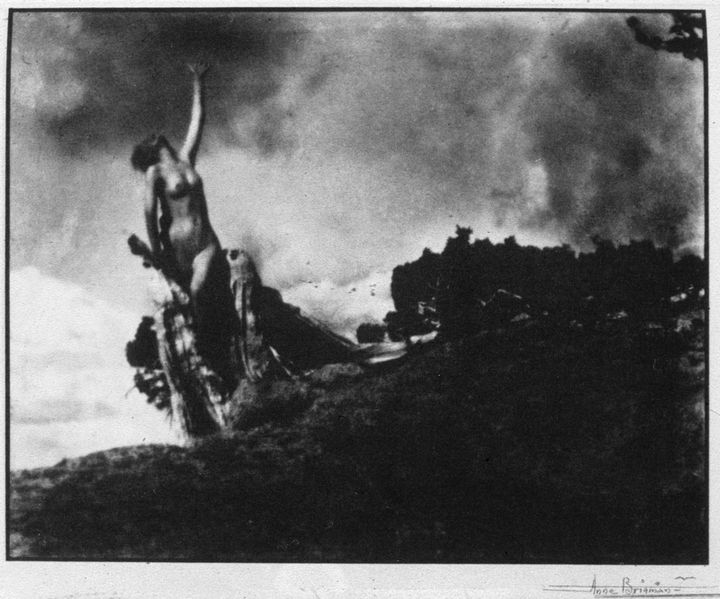
She received the Birmingham Society's first silver medal for the photograph entitled, "Soul of the Blasted Pine," in which she photographed herself  in a dramatic tableau.

Anne Brigman
Soul of the Blasted Pine
ca. 1908
Photogravure
 6 1/8 x 8 3/8 inches
Yale Visual Resources Collection
In 1906, Brigman was listed as a Fellow of the Photo-Secession, the only photographer west of the Mississippi to be so honored. [3] In 1908, the Secession Club held a special exhibit of her photographs in New York and, in 1909, she won a gold medal in the Alaska-Yukon Exposition, as well as awards in Europe. [4] In 1910 she and her husband separated so she could "work out my destiny," and she eventually lived on her own. She continued to exhibit over the years and was included in the landmark International Exhibition at the Albright-Knox Art Gallery in New York in 1911, and the International Exhibition of Pictorial Photography in San Francisco in 1922.


Anne BrigmanSelf-Portrait
ca. n.d.
Alfred Stieglitz and Georgia O’Keeffe Archive
 In terms of her work, by the 1940s, Brigman's work evolved from a pictorial style to a straight photography approach, although she never completely abandoned her original vision. Her later close-up photos of sandy beaches and vegetation are expressive abstractions in black-and-white. In the mid-1930s Brigman began taking creative writing classes and she was soon writing poetry. Encouraged by her writing instructor, she put together a book of her poems and photographs entitled Songs of a Pagan. She successfully found a publisher for the book in 1941, but because of World War II the book was not printed until 1949, one year before her death. Brigman died on February 8, 1950 at her sister's home in El Monte, California.

Anne BrigmanThe Breeze
n.d.
Photograph, from a “paste-up” for Brigman’s book Songs of a Pagan
Anne Brigman Papers
Brigman's counter-cultural images suggested bohemianism and female liberation. She explored the female form in the natural landscape that anticipates late twentieth-century ecofeminism and the societal and cultural connections it draws between women and the environment. [5] Her work challenged cultural norms and defied convention, instead, embracing pagan antiquity. The raw emotional intensity and barbaric strength of her photos contrasted with the carefully calculated and composed images of Stieglitz and other modern photographers of her day.
 ________________________________________
1. "Society Views Works of Art -- Photographer's Second Salon Proves Success - Sepias in Platinum Mingle With Bromides and Bichromates". The San Francisco Call. 1902-01-10. Retrieved 3/ 25/2013.
2. The J. Paul Getty Museum, Artists: Anne W. Brigman,  http://www.getty.edu/art/gettyguide/artObjectDetails?artobj=107700, Retrieved March 25, 2013.
3. Susan Ehrens (1995). Original A Poetic Vision: The Photographs of Anne Brigman. Santa Barbara Museum of Art. p. 23.
4. "Work of Oakland Artist Captures Coveted Honor - Wins Gold Medal for Lens Studies - Annie W. Brigman Given Honors for Exhibit at Alaska-Yukon Exposition". The San Francisco Call. 1909-11-11. Retrieved 3/25/2013.
5. Yale Archive Library,  Intimate Circles: Women in the Arts, Anne Brigman, http://brbl-archive.library.yale.edu/exhibitions/awia/gallery/brigman.html, retrieved 3/26/2013.

Thursday, March 21, 2013

Anne Millay Bremer: Crusader for the Modern Movement

Anne Millay Bremer
An Old Fashioned Garden
c.a. No date
Oil on canvas
20 x 24 inches
Mills College Art Museum
Anne M. Bremer (1868-1923) was a native Californian who grew up in San Francisco. Influenced by cubism and futurism, Bremer was a modernist painter known for still lifes and landscapes and who was praised for her use of vibrant color and dramatic line. She was a respected artist whose enjoyed continuous and loyal support for her work.

Anne Millay Bremer
The Highlands
c.a. No Date
Oil on canvas
30 1/4 in. x 36 inches
San Francisco Museum of Modern Art
In 1889, Bremer began her art studies in the city at the Art Students' League, San Francisco under Arthur F. Mathews and Emil Carlsen. [1] She attended the California School of Design, Mark Hopkins Institute of Art, San Francisco, under directorship of Arthur Mathews in1897and 98, after which Bremer received a University of California Certificate of Proficiency, in Drawing. In 1910-1911, she studied with André Lhote and at the Academies Julian, Moderne and La Palette, and while there exhibited at the Salon d'Automne in Paris. Her painting style underwent a dramatic change from moody, tonalist portraits and landscapes to a gestural abstraction akin to Cezanne and van Gogh.When she returned to San Francisco, Bremer remained active as an artist and a teacher in the city.

Anne Millay Bremer
Cypress at Saratoga, California
c.a. 1917
Oil on canvas
25.25 x 30.25 inches
Monterey Museum of Art, Exhibited Arlington Gallery, NYC, 1917 
Anne Bremer never took a studio in low-rent building known as the the Montgomery Block which housed numerous women and became the hub of artistic activity in San Francisco, [2] however, she was closely associated with the "Monkey Blockers," in that Bohemian enclave that was modeled after Montmartre in Paris. A socialist, Bremer was active in the fight for both artists' and women's rights. She served as president of the Sketch Club in the 1900s during which time she organized what might be the most critically acclaimed women's exhibition to date in February 1906 and was instrumental in leading the artists through the fallout of the earthquake that followed just two months later. [3]

Anne Millay Bremer
Sentinels
c.a. 1917
Oil on canvas
40 x 35 1/4 inches
San Francisco Museum of Modern Art
Bremer was praised for capturing "the peculiar light of varied California weather, sensitive to both dull and bright effects." [4] In addition, she was considered one of the most advanced artists with a style and technique that was much more modern than her contemporaries. Bremer’s work incorporates several elements associated with modern painting-each of her pieces utilizes the flat surface that holds the arrangement of paint, not as a literal representation or illusion of reality. Her brushstrokes are broad and distinct from one another, sometimes with areas of unpainted canvas showing through. There is either very little suggestion of depth, or the perspective is distorted or ambiguous. Colors are bold and not always found exactly as they appeared. The subject may be figures, landscape, still life, or a combination, but what was more important to Bremer was creating a successful composition and emotional effect. Hartley once wrote that in his opinion Anne Bremer was “one of the three artists of real distinction that California has produced.”[5] 

Anne Millay Bremer
Ravenlocks
c.a. 1920
Oil on canvas
30.50 x 25 inches
Mills College Art Museum
Anne Bremer
Still Life with Brass Bowl and Flowers
c.a. No Date
Oil on Canvas
25 x 30 inches
Alfred Bender Collection
From a feminist standpoint, modern art was slow to catch on in Northern California, however, many of its earliest supporters were women, despite the attitudes of various male instructors such as sculptor Ralph Stackpole, who told the women in his sculpture class "the place they really belonged was in bed."[6]  In San Francisco, those women modernists who were judged to have a "masculine" hand were the most critically acclaimed as they employed a direct, simple and powerful technique in their work...traits most desired in painters during this period.

Anne Bremer was diagnosed with leukemia in 1920. She gradually moved away from painting and spent her days writing until her death in 1923.

___________________________________________

Member: San Francisco Society of Women Artists; San Francisco Art Association (board of directors); San Francisco Sketch Club, (Pres. 1905-7).

Exhibited: Del Monte Art Gallery (Monterey), 1907-14; Salon d’Automne, Paris, 1911; Society of Washington Artists; Pennsylvania Academy of Fine Arts; Society of Independent Artists, NY; San Francisco Art Association, 1903-22; Panama-Pacific International Exhibition, 1915; de Young Museum, 1915, 1916; Hill Tolerton Gallery, San Francisco, 1916, 1922; Arlington Galleries of New York, 1917; San Francisco Palace of Fine Art, 1919, 1923; San Francisco Print Rooms, 1923; .

Works held: Mills College Art Gallery, Oakland; Oakland Museum; San Jose YWCA (memorial panel); Mt. Zion Hospital, San Francisco (mural); Monterey Peninsula Museum of Art; San Francisco Museum.

____________________________________________
1. Phil Kovinick and Marian Yoshiki-Kovinick, An Encyclopedia of Women Artists of the American West (Austin: University of Texas Press, 1998), 29.
2. Patricia Trenton, ed. Independent Spirits: Women Painters of the American West, 1890-1945 (Los Angeles: University of California Press, 1995), 23.
3. Ibid.
4. Porter, Garrett, "Miss Bremer Pronounced One of San Francisco's Most Talented Painters," San Francisco Call, September 15, 1922.
5. As quoted (or paraphrased) by Ruth Pielkovo, San Francisco Journal, April 2, 1922; original source unknown.
6. Dorr Bothwell, interview with author, September 25, 1993.

Tuesday, March 12, 2013

Lucia Mathews: Painter in the Shadow


Lucia K. Mathews
1870-1955
 Scrapbooks kept by painter couple Arthur and Lucia Mathews from the late 1890s to the 1920s, the period which covered the apex of their careers, is a voluminous book devoted to Arthur's successes. Dozens of clippings depict his triumphs, as Lucia's accomplishments, in contrast, are overlooked. A prolific artist, Lucia never had a one-woman show and the press was generally  silent about her work. [1]

How is it that an artist who trained in Paris with James McNeill Whistler, who maintained her own art studio in San Francisco for years, and whose association with that world included William Merritt Chase, remained unrecognized in her lifetime? The answer lies in the issues that surrounded gender and artistic identity at the turn of the century in Victorian Northern California. While Arthur decorated the foyers of theatres, libraries and the ornate mansions of the wealthy, Lucia worked in pastel and watercolor. She preferred small-scale works. Her subjects were domestic scenes.

Lucia was born Lucia Kleinhans in San Francisco and attended Mills College for one year before enrolling in the Mark Hopkins Institute of Art, at which her future husband was the Director. They married in 1894. [2] Lucia Mathews and her husband, Arthur, were two of the most prominent artists in Northern California in the early 20th century. They were leaders in what became known as the California Decorative Style, the West Coast version of the Arts and Crafts Movement. Their philosophy (like that of architect Julia Morgan) was that one's environment should be in total harmony and that people should surround themselves only with objects they consider beautiful.

Lucia Mathews
Three Women Standing in a Window
Oil on canvas
23 ½ x 31 inches
n. d.
When the 1906 earthquake and fire struck San Francisco, the couple saw an opportunity to rebuild an entire city according to the philosophy of the Arts and Crafts style. They opened the Furniture Shop in the California Street home of John Zeile, a wealthy arts patron, and hired seasoned craftsmen, many from Europe, who trained to execute their design ideas.


Lucia Mathews took the lead in interpreting various motifs, oversaw the color selections, and learned wood carving and painted decorative scenes. Classical figures in Grecian costumes (one of Arthur Mathews' preferred themes) as well as botanical images (Lucia's specialty) were dominant images. She liked floral designs from native plants such as the California poppy, and often incorporated Oriental motifs. Both she and her husband built their own picture frames.
Lucia Mathews
California Poppies
in a Tall Goblet
Gouache, gold lead and ink on paper
ca. 1890s
Oakland Museum of California


Lucia preferred a flat, graphic style of rendering figures, flowers, and landscapes. Lucia's preferred flower was the California poppy, a flower that covered the hills around the San Francisco bay.
Lucia Mathews
Poppy Box
ca. 1929
Polychrome
5 in. high x 16 in. wide x 12 in. deep
Oakland Museum of California


Lucia Mathews
Painted Jar
ca. 1900s
The Furniture Shop
Oakland Museum of California
Lucia Mathews
Pine Tree
Watercolor on canvas paper
Lucia proved to be an exceptional painter on wood, creating sumptuous multicolored frames for her husband's paintings on gilded wood jars and bowls, patterned with miniature mural scenes. [3] An avid and skilled gardener, Lucia was an adviser to the designers of Golden Gate Park in San Francisco. In later years, both Lucia and Arthur turned to painting scenes of the seashore, perhaps influenced by the rise of the California impressionist movement. Lucia's views of the coast, with cypress and pines tree in the foreground, are rendered in a looser, more painterly style.
______________________________
1. With the exception of one and two line newspaper reports on their silver medal for the Panama-Pacific International Exposition. (see "The Exposition Awards: California Artists," San Francisco Chronicle, July 25, 1915).
2. Lucia Mathews (1870-1955), http://www.hardygalleries.com/Default.asp?Page=70, (accessed March 11, 2013), source: "American Women Artists" by Charlotte Streifer Rubenstein.
4. Michael S. Gant, California Dreaming, Metroactive http://www.metroactive.com/metro/12.13.06/arthur-and-lucia-mathews-0650.html, (accessed March 11, 2013). 


Friday, March 8, 2013

Malvina Hoffman: Artist of the World


Malvina Cornell Hoffman
1885-1966
Malvina Cornell Hoffman was an American sculptor and author. She was born and grew up in New York City. Although she was primarily a woman of the East, she spent a good deal of her life traveling to look at, photograph, and sculpt people of other ethnicities, including Native Americans in the western United States. Her father, Richard Hoffman, a British-born,  prodigy, was a pianist with the New York Philharmonic at just sixteen years old. Three years later he was hired by P.T. Barnum as an accompanist for Jenny Lind, the so-called Swedish Nightingale, on her first American tour.[1] The Hoffmans' Manhattan home on West 43rd Street was a popular gathering place for artists and musicians and, as a result, Malvina was exposed to creative people from a young age.

A precocious child, Hoffman showed an early interest in art and, at fourteen, began taking classes at the Woman's School of Applied Design to study drawing and painting. She soon added classes at the Art Student's League where artists such as Raphael Soyer, Isabel Bishop, and  Kenneth Hayes Miller, taught and studied. In addition, Hoffman spent time in Paris where she was a student of French sculptor Auguste Rodin from 1910 until his death in 1917, and she is recognized by some as "America's Rodin."[2] Hoffman first won acclaim for her bronze sculpture of Russian dancers Anna Pavlova and Mikhail Mordkin. Her sculpture, Russian Dancers, the study of Pavlova and her partner, received a first prize at the Paris Salon in 1911. Hoffman also studied Gutzon Borgium, sculptor of Mount Rushmore at the Women’s School of Applied Design and the Arts Students League. Hoffman had firmly established her reputation as a sculptor by the mid-1920s.

Stanley Field and Malvina Hoffman at her Paris Studio. © The Field Museum
 
Malvina Hoffman
Semang Pigmy
 ca. 1930
Bronze
27 1/4  x 7 7/8 inches
Edition 1 of 5
In the 1930s, anthropology became a recognized discipline at the University of Chicago, with many prominent figures in the field in residence. Working closely with the anthropologists, Stanley Field, director, and the nephew of the founder, of the Field Museum of Natural History in Chicago commissioned Hoffman to create sculptures of people representing members of the diverse groups of humans in cultures around the world. She received an offer to join four other sculptors in a project that would represent all of the world's ethnic groups to be finished in plaster. Hoffman convinced the museum directors that the project should be completed by one artist to guarantee consistency of style, and cast in bronze to ensure permanency of the figures. 

Her monumental bronze series, The Races of Mankind, included one hundred five busts and full figures of typical types of people from Africa, Europe, Asian, and the Americas.[3] In preparation for the exhibit, Hoffman and her husband, S. B. Grimson, traveled throughout the world to find authentic models for the sculptures, which took five years to complete. The collection became a permanent exhibition at the Field museum, which was popular for both for its artistic and cultural values, however, it was not without controversy.


The Races of Mankind, located in the Chauncey Keep Memorial Hall. The exhibit was visited by over 2 million people in its first year.
© The Field Museum,

At that time, Hoffman's work was criticized by social scientists as too reliant on physical over cultural characteristics. The prevailing abstract artists of the day saw her work as either too realistic or too romanticized.[4] At the end of the project, she felt “this collection of bronze figures and heads is a sculptor’s interpretation of Humanity, studied from three angles—Art, Science, and Psychology. It represents not only the actual study and work of the past five years, but the result of my observations and study over a period of many years previous to 1930.” (Hoffman, 1936) [5]Although her western sculptures, done as part of the Races of Mankind project, are a small component of the overall project, her studies of Native Americans of the Southwest, South Dakota, and Montana have been shown widely.

Malvina Hoffman
Apache Man
ca. 1934
Bronze
No size given
The ensuing years have found both critics and the museum itself taking a less judgemental position on the Races of Man project. Hoffman's work is now seen not as a simplification of ethnic types, but as extraordinary recreations of vibrant individuals from different cultures. The figures reveal more than just technical prowess and anatomical detail; they express a feeling of movement, and they exude life. Hoffman also spent time painting and drawing in the west and her titles included John McCormick, Cowboy, Sage Brush, California; Ranch, Sierra Nevadas; May Night, Sierra Navadas; and Spring in the Desert, Southern California.

Malvina with her close friend, Ballerina Anna Pavlova.
n.d. 
Hoffman wrote three books about her life and her career: Heads and Tales (1936), Sculpture Inside and Out (1939), and Yesterday and Tomorrow (1965).  Malvina Hoffman died at her studio-home in New York, New York, on July 10, 1966. Her work is represented in the collections of the American Museum of Natural History, New York; American War Memorial Building, Epinal, France; Carnegie Institute, Pittsburgh; Corcoran Art Gallery, Washington, D.C.; Glenbow Foundation, Canada; Luxembourg Museum, Paris; Memorial Chapel, Harvard University, Cambridge, MA; Imperial War Museum, London; Metropolitan Museum of Art, New York; and Stockholm Museum, Sweden.
__________________________________
1. Encyclopedia.com, Malvina Cornell Hoffman, http://www.encyclopedia.com/topic/Malvina_Hoffman.aspx. (accessed March 7, 2013).
2. Ibid.
3. Phil Kovinick and Marian Yoshiki-Kovinick, An Encyclopedia of Women Artists of the American West (Austin: University of Texas Press, 1998), 145.
4. Sandy Cline, Soapstone Sculpture, Malvina Hoffman, A Tribute,  http://soapstonesculpture.com/malvhoff.html (accessed March 8, 2013).
5. Kovinick, 146.

Tuesday, March 5, 2013

Elsie Palmer Payne: Illustrator and Painter

Elsie Palmer Payne
with husband Edgar
ca. 1913 Photograph
California artists Elsie Palmer Payne and her husband Edgar Alwin Payne have each created a body of work that is distinct and original, yet while Edgar earned a reputation as a leader of the California landscape painters, Elsie's work has been unfortunately overlooked. When she discussed her career in relation to her husband's, she remarked with a note of bitterness, (Edgar) "never gave me time to paint! I was always busy waiting on him, packing and unpacking." [1] Edgar, a man firmly entrenched in Victorian values, held the position that "no matter how talented or able, a woman's place was to be at her husband's beck and call." [2] Although he did admire his wife's talent, he never promoted Elsie's work, or encouraged her to pursue a career, although she was a well-established, successful commercial artist when they met.

Elsie always had an interest in art, After graduation from high school, Elsie attended the Best Art School in San Francisco for her formal art training during the years 1903 to 1905. She pursued a classical curriculum beginning with drawing from antique casts, life drawing, to the use of color. During and after her studies from 1904-1907, Elsie worked in advertising for the Rimes Illustrating Company in San Francisco and later, for the firm of Verney and Green. [3] Elsie was a respected and successful commercial artist earning an excellent living on her own. In 1909, she met Edgar Payne in San Francisco and married him in Chicago on November 1912. Edgar was just emerging as a self-taught artist when they married and was beginning to be recognized for his work in the Chicago area and on the East Coast.

During their marriage, the couple spent time intermittently in Chicago where Elsie would assist Edgar with his mural commissions. Her drawing skills allowed her to sketch the figures while he painted them. Her work was similar to the style of American Illustration at the turn of the century and relied on lines and strong bold colors that focused on emotional appeal and decoration. [4] In 1918, they spent time sketching in Laguna Beach California, where they were founding members of the Laguna Beach Art Association. From 1919 until 1931, Elsie and Edgar traveled and painted in the American Southwest, Canada, Paris, and New York. The couple finally settled in Los Angeles in 1931...their daughter, Evelyn, born in 1914, attended almost a dozen different schools before she entered high school.


Elsie Palmer Payne
Carmel Coast
ca. 1935 (?)
Oil on Canvas
 Separated from her husband in 1932 because her disenchantment with Edgar's domineering and old-fashioned attitudes towards women, Elsie began to teach and paint in her Beverly Hills studio and later, opened the Elsie Palmer Payne Art School and Gallery in 1936. She became active in a number of organizations, including the Women Painters of the West (founding member), the National Society of Arts and Letters, and the California Art Club. Later, wehen her husband's health began to fail, Payne reunited with him to care for him until his death in 1947. She carried on the promotion of his paintings and his book while she continued her own career.

Elsie Palmer Payne
A Decent Burial
ca. 1942
Oil on Canvas
26 x 31 inches
Her 1942 painting A Decent Burial, based on an experience in Italy years before, won recognition and several prizes. During World War II she made pastel portraits of servicemen at local USO clubs and presented them to the Her later work including Bus Stop and The Thrifty Drug Store, painted in 1945, were American Scene compositions that resembled the Ashcan School treatment of subject.
Palmer worked in Los Angeles until 1969. She moved to Minnesota to spend her last years in Minneapolis with her daughter. 


Elsie Palmer Payne
Bus Stop
ca. 1943
Oil on canvas

Elsie Palmer Payne
The Thrifty Drug Store
Oil on canvas
ca. 1945
28 x 36 inches
As previously discussed, early in their marriage, Elsie assisted her husband with mural comissions and sketched alonside him as they traveled, yet her work was not influenced by him. In addition to oil, she used gouache and watercolor, and painted in a style that was uniquely her own. Unlike Edgar, she also sculpted. Her artistic themes included the West, flower studies, portraits, and genre scenes in Los Angeles.

Elsie Palmer Payne
Still Life
Oil on canvas
ca. 1940s
20 x 24 inches
 Exhibitions from 1913-1967 included those of the Palette and Chisel Club and AIC, both in Chicago, the Laguna Beach Art Association, Galerie Jacques Seiligman, Paris, the Bowers Museum in Santa Ana, Los Angeles County Museum of Art, Woman Painters of the West, California Art Club, Ebell Club, Los Angeles, Greek Theatre, Los Angeles, Pasadena Art Institute, Laguna Beach Art Association.

Retrospective exhibitions of her work were held at the Carnegie Art Museum, Oxnard, California (1988), and Petersen's Galleries, Beverly Hills, California (1990).


____________________________________
1. Cohen,Rena Neumann, The Paynes, Edgar & Elsie: American Artists (Minneapolis: Payne Studios, 1988), 72.
2. Cohen, The Paynes, 71.
3. Phil Kovinick and Marian Yoshiki-Kovinick, An Encyclopedia of Women Artists of the American West (Austin: University of Texas Press, 1998), 244.
4. George Stern Fine Arts, .Elsie Palmer Payne (1884-1971), http://www.sternfinearts.com/elpapa1.html. (accessed March 5, 2013).