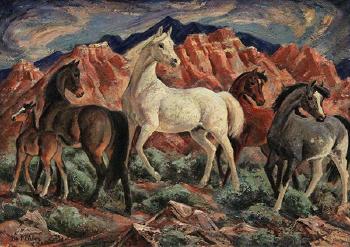
Thursday, April 10, 2014

Abby Williams Hill: Tacoma Painter and a Woman before her Time

Abby Williams Hill
ca. 1870s
I am so inspired by the story of Abby Rhoda Williams Hill (1861–1943) and I hope you are as well. Abby was a painter and an activist with a love of travel and learning. Her artwork provides a lasting vision of many of the iconic sights of the American West, and her papers paint a rich picture of American life between the Civil War and World War II. Hill was an intrepid explorer who loved to be in the wilderness, unhampered by societal codes of dress and behavior, She was a Progressive and firm advocate to the Congress of Mothers (today’s National Parent Teacher Association) and lobbied on behalf of disadvantaged children, African Americans, Native Americans, and other marginalized groups.

Abby Hill grew up in Grinnell, Iowa, with much encouragement in her art by her parents and received early art training from her aunt, a botanical watercolorist. She studied at the School of the Art Institute of Chicago in 1883, and then, at the Art Students League in New York under the tutelage of William Merritt Chase. After her marriage to Dr. Frank R. Hill in December of 1888 in Brooklyn, New York, the couple moved to Tacoma, Washington, just as Washington Territory became the 42nd state. They remained there and at nearby Vashon Island until 1910. While a resident there, Hill continued her art training in Munich (1895-97) with Herman Haase, and at the Corcoran Gallery School, Washington, D.C. in 1905 when she made the decision to pursue painting as a career.

Abby and Frank Hill
ca. N.D.
Hill was far from the typical Victorian woman. When her husband, Frank, demanded she wear a corset and bustle like other genteel housewives of the period, she negotiated. If he would agree to wear the uncomfortable undergarments for a day, and if, after that experience, he still expected her  to do so, she would acquiesce. A reasonable man, Dr. Hill agreed to the experiment and never again asked his wife to squeeze herself into an hourglass shape in the name of fashion.

During their time in Washington, Hill reared a family of four children. Her first child, son, Romayne Bradford, was born partially paralyzed, but with her love of the outdoors and belief that fresh air and exercise would be the tonic needed to help her son, she dedicated the next six years to his health. Over the ensuing years, the Hills adopted three more children (all girls) all of whom would accompany her on local camping trips and travels, typically without Frank.

Hills' independent spirit is difficult to appreciate during our time in which women have so much freedom and so many opportunities. The Victorian era dictated strict rules of behavior for women that Hill largely disregarded. She often headed into the wilderness to paint in remote places, usually accompanied by at least two of her children — which made traveling even more of a challenge. At her campsites, she kept a journal, describing her encounters with snakes, landslides, Indians on horseback, rain, wind and, at one point, such intense heat that she couldn't pick up her metal paint tubes without burning her fingers.

Abby Williams Hill
Horseshoe Basin
ca. 1903
Oil on canvas
University of Puget Sound
In 1909, Dr. Hill suffered a mental breakdown that left him catatonic for weeks at a time. Forced to leave Tacoma due to her husband's recurring illness, diagnosed as Psychotic Depression, Hill moved the family to Laguna Beach, California, then a remote, burgeoning artist colony. Abby became a founding member of the Laguna Beach Art Association.

Dr. Hill became a patient at various hospitals and for years, Hill cared for him and surrendered much of her time dedicated to painting to help him recover. When he was released in 1924, she bought an automobile to allow the family to winter in Tucson Arizona, travel to the Deep South, and explore a number of locations in the West. Unfortunately, in 1931, Dr. Hill's illness forced him to return to the hospital in Southern California, so Abby settled in nearby San Diego to be available when her husband needed her.
Abby Williams Hill
Balsatic Rocks
ca. 1904
Oil on canvas
44 x 34 inches
The Athenaum
Abby Williams Hill
Grotto Playing
ca. 1906
Oil on canvas
17 x 22 inches
The Athenaum
Hill became a painter of the West in the 1890s. Her most widely displayed artwork was created during the first decade of the twentieth century when she was commissioned by both the Northern Pacific and Great Northern Railroads to produce a series of landscapes of the scenes along their routes. Abby was to create 22 oil on canvas pieces in 18 weeks while traveling on trains, handcars, stages, steamboats, and horses. In exchange for the use of her work, she was given four tickets, each worth one thousand miles. Hill would travel to the most remote locations to record the beauty of the west, and at the end of her journey, surrender her canvases and her rights to them to the railroads. In addition, as a woman traveling without male companionship, she was vulnerable to unwanted attention from men who made certain assumptions about her character. Hill braved the discomfort of heat and cold, trudged across snowfields, organized baggage and cared for her children, often brought along on her expeditions. Her assignments took her to such rugged locations as remote terrain in Washington, Idaho, Montana, and other areas west of the Cascades.

Abby Hill camping with her four children
Probably before 1910
During this period, Hill met and painted a number of Native Americans including the Flathead of Montana, the Nez Perce of Spalding, Idaho, the People of north-central Montana at Harlem, and the Yakima of Washington. She considered the Native Americans her friends and portrayed them with dignity and respect. She bartered with the Flathead to exchange English lessons for dancing lessons, and, with a list of grievances, wrote to Washington, D.C. on their behalf.
ca. n.d.
Oil on canvas
Missoula Art Museum
Chief White BullTa-tan-ka-sha
Minniconjou Sioux, Flathead Reservation, Montana
ca. 1905
Dakota-Lakota-Nakota Human Rights Advocacy Coalition
Following the death of her husband in 1938, Abby Hill became bedridden. She died in Laguna Beach  in 1943 five years later.

Hill's exhibitions included those of the Western Washington Industrial Exposition, Tacoma; World's Columbian Exposition, Chicago; Lewis and Clark Exposition, Portland, Oregon, Louisiana Purchase Exposition, St. Louis, Jamestown Centennial, Hampton Roads, Virginia; Alaska-Yukon-Pacific Exposition (two gold medals), Seattle; and Laguna Beach Art Association. The University of Puget Sound held an exhibition of her works in 1964.

Abby Williams Hill is represented in the collections of Ames College, Iowa, Grinnell College, Iowa, and a permanent collection of her works and papers is held by the University of Puget Sound.
_____________________________________________
Sources
University of Puget Sound, Abby Williams Hill Collection, http://www.pugetsound.edu/academics/academic-resources/collins-memorial-library/archives/abby-williams-hill-collection/, retrieved April 7, 2014.
Abby Williams Hill: Unfettered in Life and Art, Shelia Farr, Seattle Times Art Critic, http://seattletimes.com/html/entertainment/2003797045_visart20.html, retrieved, April 7, 2014.
Chattermarks from North Cascade Institute, http://chattermarks.ncascades.org/?s=abby+Williams+Hill+in+the+North+cascades, retrieved April 8, 2014.
An Encyclopedia of Women Artists of the American West, Phil Kovnick and Marian Yoshiki-Kovnick, University of Texas Press, 1998.
Dakota-Lakota-Nakota Human Rights Advocacy Coalition, http://www.dlncoalition.org/dln_nation/chief_white_bull.htm, retrieved April 10, 2014.
National Parks and the Woman's Voice: A History, Polly Welts Kaufman, New Mexico Press, 2006.

Friday, March 28, 2014

"I MUST paint...it's a disease" Minerva Kohlhepp Teichert

Minerva Kolhepp Teichert
When she wrote her memoirs in the late 1940s, painter Minerva Kohlhepp Teichert recalled the moment when her future as a Western woman artist became clear. She attended a critique in Robert Henri's portraiture class at the Art Students League in New York where she studied from 1915 to 1916. Henri asked her if anyone had ever visually told the "great Mormon story" and Teichert answered no, not to her satisfaction. Henri advised, "Good Heavens, girl what a chance. You do it. Your're the one!" Teichert left New York soon thereafter, returned to her family's homestead in Idaho, near the Utah border, married her "cowboy sweetheart," did the books for the family ranch, raised five children and painted almost every day of her life.

 Minerva Kohlhepp was born in North Ogden, but grew up in a  homestead farming family in the vicinity of American Falls, Idaho. Her father encouraged her sketching in childhood and she soon developed an "indomitable will to succeed and excel in the field of art."

Minerva left home for the first time at age fourteen to work as a nursemaid for a wealthy Idaho family in San Francisco where she was exposed to art in museums for the first time, and attended classes at Mark Hopkins Art School. However, it was not until she graduated from high school and taught for several years that she was able to pursue any serious art training. By age nineteen, she scraped together enough money to get to Chicago, where she studied at the Chicago Art Institute under the draftsman, John Vanderpoel, a master of the academic school of painting. Several times during her three-year course work she returned home in order to earn more money in the fields or in the classroom to get back to school to follow her dream. To finance her study in New York, she created a roping act for the New York stage and this is when she began her custom of wearing a distinctive head band. 
Minerva Kohlhepp Teichert
Hole-in-the-Rock
n.d.
Oil on canvas
LDSArt.com


Minerva quickly emerged as a top student in her popular art classes. When questioned about her choice of subjects for her art, she’d say, “There’s too much sagebrush in my blood to forget the beauties of rugged mountains [and] dry plains.” She was recognized for the excellent quality of her animal paintings as well. For over half a century, Teichert painted hundreds of murals and easel paintings for churches, schools, and private patrons throughout the Rocky Mountain region. Well-known throughout the Mormon community, Teichert's obscurity in the art world may be due to her particular attention to Mormon history and theology. She concentrated her work on scenes from western Americana and religious artwork that expressed her deeply held convictions.

Teichert painted over 400 murals in which women and western themes feature prominently such as The Madonna of 1847, which depicts a mother and child in a covered wagon, crossing the plains to settle in Utah. Teichert is known for a set of 42 murals from the Book of Mormon, as well as her murals inside the Manti Utah Temple. Teichert's distinctive style can be seen in the painting Christ in a Red Robe, in which women can be seen reaching out to Christ, who is depicted in a red robe at his second coming, referencing Isaiah.

Minerva Kohlhepp Teichert
Christ in a Red Robe
ca. 1945
Oil on canvas
LDS Museum Store Online
 
During the 1930s, early in the Great Depression, Teichert's commitment to her art work began to pay off. Like most everyone else, the Teicherts were struggling to make ends meet. Minerva was determined to contribute with her artwork, but she needed to reach out to a larger market. She traveled to Salt Lake City in search of an agent. At a meeting with Alice Merrill Horne, a well-connected art dealer in Utah, she unrolled a mural and said simply, “Please look at this.” Horne was astonished. Just two weeks later, Horne had arranged an exhibit of Teichert’s work and within months, Teichert would meet with the governor of Utah and receive enthusiastic reviews of her art in major Utah newspapers. In 1932, when the Teicherts’ economic situation reached a crisis, Horne found several buyers, and Teichert’s paintings saved the ranch.

As Teichert’s profile rose in Utah, the artist continued to explore stories of the Mormon migration and scriptural themes. By 1947, she had risen to the top of the Mormon art world, winning first prize in the Church’s centennial art contest and became the first woman invited to paint a temple mural.
Teichert increasingly felt it was her responsibility to tell the Book of Mormon story in images so that “he who runs may read,” a common phrase from the time taken from the book of Habakkuk. After finishing the Manti Temple mural, she set out on what she expected to be her masterwork—42 paintings of Book of Mormon stories, rendered large enough and simple enough to be “read” at a glance.
Minerva Kohlhepp Teichert
Handcart Pioneers
ca.1940
Oil on canvas
 77 x 49 inches
Brigham Young University Museum of Art, Provo, Utah
Finishing the paintings in 1952, the 64-year-old Teichert anticipated how the works might accompany the Book of Mormon text, or be used as slides by missionaries around the world, or be sold as a book of paintings. Unfortunately, they were never sold. She was praised for her beautiful art work, but no one bought the paintings, and, for the remainder of her life, she strove to find a buyer. Her longtime agent and friend died, murals became less popular and tastes changed. It became more difficult for Teichert to get commissions and to sell her work. Not to be discouraged, she continued to paint, she found a new agent, and her artwork with western themes became marketable in Utah and beyond.

Minerva Kohlhepp Teichert
Queen Esther
ca. 1939
Oil on Canvas
14 x 9.7 inches
Collection of Betty Curtis and William Lee Stokes 
In the spring of 1970, Teichert fell from her porch and broke her hip, possibly after suffering a stroke. She would never paint again. She died in 1976. The story does not end here, however. In 1969 she had given the Book of Mormon paintings to Brigham Young University with no compensation or promise of publication. Upon receipt BYU showed the paintings briefly, then stored them away. In 1997, after the resurgence of interest in her work, BYU held a major exhibit of the Book of Mormon paintings and created a companion volume of the collection. BYU religion professors also lobbied to have Teichert’s Book of Mormon series line the hallways of the Joseph Smith Building, making it possible, in effect, for those who run to Book of Mormon class to read.

Her work was re-discovered after her death with a new appreciation for her excellent technique and the enormity of her body of work. Teichert's works are displayed at the campus of BYU including the Museum of Art. One of Teichert's most famous exhibits, "Pageants in Paint," has been on display in the BYU Museum of Art. The exhibition examined how the American mural and pageantry movements influenced Teichert’s artistic production through 47 of her large-scale narrative murals.


Minerva Kohlhepp Teichert
Return of Captive Israel
ca. 1945
53 1/2 x 90 inches
The Church of Jesus Christ of Latter-day Saints,
Relief Society Building, Salt Lake City, Utah
 
During her many active years, Teichert had one-person exhibitions at the Washington Museum, New York (1915), and at the Alice Merrill Horne Galleries, Salt Lake City (1932, 1939). Among group shows, she hung works at the Idaho State Capitol, Boise; Springville Museum of Art, UT; First National Exhibition of American Art, New York; and event of the Wyoming Artists Association.

____________________________________________________________
Sources:
Painting the Mormon Story, Peter B. Gardner, http://magazine.byu.edu/?act=view&a=2124, (retrieved 3/28/2014). 
Brigham Young University News Release, Opening reception for “Minerva Teichert: Pageants in Paint” Sept. 26 at MOAhttp://news.byu.edu/archive07-Sep-pageant.aspx (retrieved 3/ 27/2014)
Independent Spirits, Women Painters of the American West, 1890-1945, Patricia Trenton, ed.
An Encyclopedia of Women Artists of the American West, Phil Kovnick and Marian Yoshiki Kovnick.


Tuesday, March 11, 2014

Ruth Armer: From the Representational to the Abstract

Ruth Armer
California Autumn
ca. n.d.
              oil on canvas        
30 1/8 in. x 38 1/8 in
SFMOMA
Ruth Armer was a painter, lithographer and teacher, whose work style ranged from her early, more representational work, to her later, more abstract art. Known today as one of San Francisco’s more profound abstractionists, many of her works feature desert scenes, giant sequoias, and her beloved city of San Francisco, among many additional California subjects. 
 
Ruth ArmerA New Dawn
ca. 1947
Oil on canvas
24 x 41 inches
 
#2
Ruth Armer
#2
ca. 1949
Oil on canvas

Ruth Armer was born in San Francisco on May 26, 1896, where she spent the majority of her career as an artist. Armer studied at the California School of Fine Arts from the years 1914-15 and 1918-19. In between, she studied at the Art Students League and School of Fine and Applied Art in New York, under noted artists/instructors George Bellows, Robert Henri, Kenneth Miller and Joan Sloan. During this time, her artistic career was greatly influenced by Leo Stein and Max Weber.
 
Armer became a painter of landscapes, musical themes, and figures in both oil and watercolor. During her career she worked as a commercial illustrator as well as a landscape and portrait artist.
After returning to California, she exhibited at Gumps San Francisco, the San Francisco Art Association and the San Francisco Women Artist Annuals, as well as galleries in New York, Cincinnati, Cleveland, Los Angeles, Portland, and Honolulu. Armer taught drawing, painting, and design in addition to children's Saturday classes at the California School of Fine Arts from 1933-1940. She served for many years on their Board of Directors. 
 
Armer participated in two competitive exhibitions at the Metropolitan Museum in New York and was invited twice to show at the Whitney Museum of American Art in New York.
 
 
Ruth Armer
#328,
ca. 1958
oil on canvas
41 7/8 in. x 28 in.
Collection SFMOMA, Anonymous gift;
 
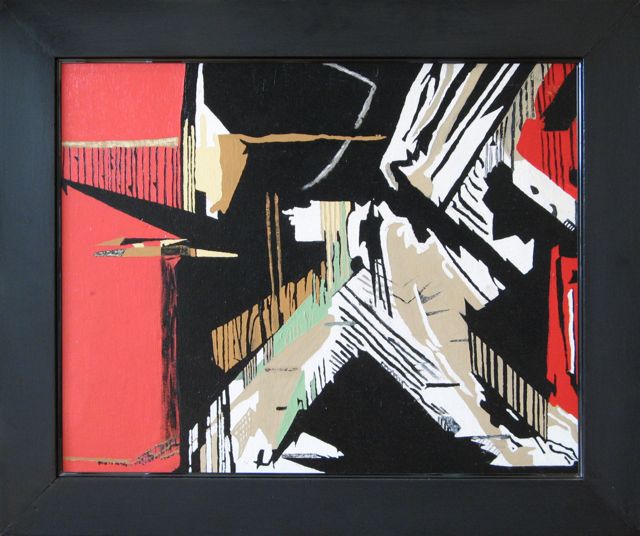
Armer's work during the 1940s could be considered a visual diary, recording the phases of her life and her responses to historical events. Her paintings during the war years had a tendency to be dark, composed of ragged shapes that recall the later work of Clyfford Still. After 1945, Armer's palette brightened, reflecting the confidence of the postwar era.
 
From the early 1940s until the early 1970s, Armer was a trustee of the CSFA and remembered the school generously in her will. In her later years she created small, abstract paintings of "orbs and illusions of vast spaces that fragment into energized squiggles, leaf patterns, and paisleys." Harvey Jones of the Oakland Museum of Art felt that Armer's work represented  the "post-Surrealism" movement of the 30s and 40s, founded by artists Helen Lundeberg and husband Lorser Feitelson. Jones felt that her artwork during that time led to her abstract work of the 1950s.
 
 
 Ruth Armer
The Light Place
ca. n.d.
Acrylic on canvas
10.125 x 14.125 inches
 
Ruth Armer
 
Ruth Armer was an active, exhibiting artist until her death on August 29, 1977 in her beloved native city of San Francisco.
 
Solo Exhibitions:
Vickery, Atkins & Torrey, 1922
Cleveland Museum of Art
San Francisco Museum of Art, 1936, 1939
Quay Gallery, 1972, 1975

Public Collections:
Oakland Museum
San Francisco Museum of Modern Art.
 
____________________________________________________________
Sources
Calabri Gallery, http://calabigallery.com/artists/ruth-armer/, retrieved March 11, 2014.
SFMOMA On the Go, Works by Ruth Armer, http://www.sfmoma.org/explore/collection/artists/1055/artwork, retrieved, March 11, 2014.
AskArt: The Artist's Bluebook, Ruth Armer, http://www.askart.com/askart/a/ruth_armer/ruth_armer.aspx, retrieved, March 11, 2014.
Sylvia Moore, ed., Yesterday and Tomorrow, California Women Artists, Midmarch Arts Press, New York, 1989.
Patricia Trenton, ed. Independent Spirits, Women painters of the American West, 1890-1945, University of California Press, 1995.
Archives of American Art, Ruth Armer Papers, 1911-1976, http://www.aaa.si.edu/collections/ruth-armer-papers-8803

Friday, February 21, 2014

Julia Bracken Wendt: Sculptor with Feminist Sensibilities

1871-1942


Notable American sculptor, Julia Bracken Wendt, was one of the few female artists ranked equally with their male counterparts during the first two decades of the Twentieth Century. Wendt was born in Apple River, Illinois, the twelfth of thirteen children in an Irish Catholic family. Following the death of her mother when she was only nine years old, she felt adrift within the family, so she ran away from home at age thirteen and was on her own.
By the time she was sixteen years old, she found work as a domestic servant for a woman who recognized her talent and drive, and paid to enroll her in the Chicago Art Institute. She studied with Lorado Taft for six years and by 1887, she became his studio and teaching assistant. Wendt earned an excellent reputation over the course of her career and was referred to as the "foremost woman sculptor of the west...whether men or women."

Julia Bracken Wendt
Music
ca. 1915
Bronze
8 7/8 x 7 1/4 inches
In 1893, during the Columbian Exposition she was one of several women sculptors nicknamed the "White Rabbits" who helped to produce some of the architectural sculpture that graced the exposition buildings. In addition, she was awarded a commission to produce Illinois Welcoming the Nations for the Fair. The work was later cast in bronze and unveiled at the Illinois State Capitol.

Wendt, who sculpted portraits, fountains, and bas-relief medallions in bronze, was not a modernist in artistic style, but she proclaimed her feminist sensibilities in her contribution to the Panama Pacific International Exposition held in San Francisco in 1915, and in San Diego in 1916. Wendt proved to be an exceptional artist and was the only woman to win a gold medal for her work.

It was Wendt who originated the idea of placing the sculptured figures that typified the attributes of woman in the Women's building of the exposition, and it was she who carried the project through to the finish. Wendt not only created the figures, she completed the work on her own. She supervised the installation and raised the statues to their pedestals when the workmen were confounded with the process. Wendt demonstrated her executive ability, creativity, and problem-solving skills with thoughtfulness and imagination. Sculpture is a demanding, physical, endeavor that requires much more strength than that of painting on paper or canvas.

After successfully pursuing her career for a number of years, Wendt married painter William Wendt and moved to Los Angeles, California, in 1906, where they became a highly prominent artist couple. Wendt taught at the Otis Art Institute and became a member of the National Sculpture Society.
Julia Bracken Wendt
National Women's Trade Union Seal
Pen and ink drawing on board
Manuscript Division
Gift of the National Women's Trade Union League
 
In 1911, she began a commission of an eleven-foot high, three-figure allegory group for the rotunda of the Los Angeles County Museum. Wendt chose to represent History, Science, and Art as draped goddesses with uplifted hands holding electrically lit globes.

 NHM Rotunda: Julia Bracken Wendt -- Three Muses (Science, History, and Art)
Julia Bracken Wendt
Three Muses (Science, History, and Art)
ca. 1911
Natural History Museum Rotunda


In 1913, she was commissioned by the government of Canada to create a King Edward Peace Memorial, which was installed at Saskatoon.


Julia Bracken Wendt's Studio
ca. 1915
Photographer unknown
Handwritten caption: CHRISTMAS GREETING FROM JULIA BRACKEN WENDT TO CHAS. F. LUMMIS

 
Julia and William had no children. Julia Bracken Wendt passed away in 1942

                                                   Julia and William in their Laguna Beach Studio


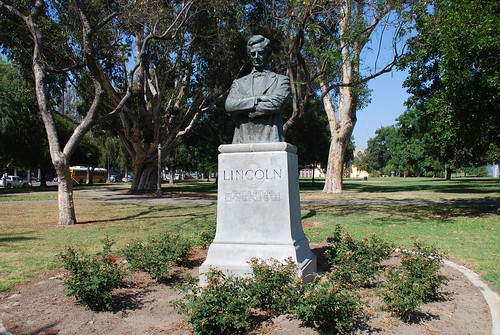
Lincoln the Lawyer
Julia Bracken Wendt
Lincoln the Lawyer
ca. 1926
Lincoln Park, Los Angeles, CA


Exhibitions: 
World's Columbian Exposition, Chicago, 1893
Annual Exhibition, Palette Club, AIC, 1895
Annual Exhibition of Works by Chicago Artists, AIC, 1899-1910 (9 times)
St Louis/Louisiana Purchase Exposition, 1904
Chicago Municipal League, 1905
Pan-California Expo, San Diego (CA), 1915
California Art Club, 1918
Solo exhibits with husband, AIC, 1909-21
National Sculpture Society, 1929
National Sculpture Society, Los Angeles (CA) Museum
Awards: 
Commission, "Illinois Welcoming the Nations" for Columbian Exposition, Chicago, 1892
Commission, Exposition Park, Los Angeles (CA). Commission, Battle Monument, Missionary Ridge (TN)
Sculpture Prize, Chicago, 1898
Municipal Art League Prize, Chicago, 1905
Gold Medal, Pan-California Expo, San Diego (CA), 1915
Harrison Prize, Los Angeles (CA), 1918
Memberships: 
Chicago Society of Artists
Chicago Municipal Art League
Society of Western Artists
Los Angeles (CA) Fine Art Association
California Art Club, Los Angeles
NAC
Three Arts Club of Los Angeles (CA)
Laguna Beach Art Association
Collections: 
Los Angeles (CA) County Museum of Art       
____________________________________________________________
Sources:
Waggoner, "The art of J.B. Wendt," Los Angeles Herald Sunday Magazine, March 27, 1910, p.1.
Edenhurst Gallery, Julia Bracken Wendt, http://www.edenhurstgallery.com/painting.php?id=1929, retrieved 2/21/14
Illinois Women Artist Project, Julia Bracken Wendt, http://iwa.bradley.edu/artists/JuliaWendt, retrieved 2/21/14
American Treasures of the Library of Congress, http://www.loc.gov/exhibits/treasures/trm167.html, retrieved 2/21/14
Yesterday and Tomorrow: California Women Artists, Sylvia Moore, ed. Midmarch Arts Press, New York, 1989.

Tuesday, February 18, 2014

Jessiejo Eckford: Dallas Native and Artist of Western Scenes

JessieJo Eckford
Mosquito Fleet Galveston
ca. 1933
Woodblock print
Painter and woodcut artist Jessiejo Eckford was born November 25, 1895 in Dallas, Texas. Her unusual name is a combination of her mother's; Jessie, and her father's; Joseph, a local judge. She lived her entire, but relatively brief life of only forty-six years in Dallas, but traveled extensively to paint around the state of Texas. In addition, she created art in New Mexico; Mexico; Massachusetts; the Ozarks; New York; and internationally when she toured the world in the mid-1920s.

Eckford began her art training in Dallas at the Aunspaugh Art School and later studied with Hale W. Bolton and Frank Reaugh in Texas. She also trained in Los Angeles and in Gloucester, Massachusetts. In 1929, Eckford won $250 in the Edgar B. Davis Texas Wildflower Competition with her painting, Prickly Pear.


Texas:Early Texas Art - Regionalists, JESSIEJO (JESSIE JO) ECKFORD (American, 1895-1941). Birches onLake Carlos, 1929. Oil on panel. 10 x 13-1/2 inches (25.4...
JessieJo Eckford
Birches on Lake Carlos
ca. 1929
 Oil on panel
 10 x 13-1/2 inches 
Prior to 1930, Eckford painted primarily in oil, but after that year, she gravitated towards working with wood blocks and watercolors.

 
JessieJo Eckford
Monterey, Mexico
ca. 1920s
Watercolor on paper
 
In 1934, she had a one-person exhibition in Dallas at the Joseph Sartor Galleries. The names of her works reflect her interest in western scenes, particularly of Texas such as Bluebonnets; Garza Prairie; and Afternoon, West Texas. There was a certain element of expressive, romantic fantasy in her buildings and landscapes.

JessieJo Eckford
Uncle Ben
ca. 1934
  woodcut on paper
6 x 8 inches 
Group shows include the California Palace of the Legion of Honor, San Francisco; Print Club of Albany, New York; Smithsonian Institution, Washington, D.C.; International Printmakers, Los Angeles, California; Washington Watercolor Club, Washington, D.C.; American Watercolor Society, New York City; Midwestern Artists, Kansas City, Missouri; and the Southern States Art League.

Eckford also exhibited in many Texas venues: the Witte Memorial Museum, San Antonio; Centennial Exposition, Dallas; Texas Fine Art Association, Austin; San Antonio Competitive Exhibition; Fort Worth Museum of Art; Dallas State Fair; and Dallas Women's Forum.

Jessiejo Eckford died in Dallas on December 5, 1941 after a long illness.

Eckford's work is in the collections of the Witte Memorial Museum, and the Elisbet Ney Museum, Austin, and the National Gallery of Art in Washington, D.C.


____________________________________________________________
Sources
Phil Kovinick and Marian Yoshiki Kovinick, An Encyclopedia of Women Artists of the American West, University of Texas Press, Austin.
University of North Texas Digital Library, Jess Edith Self, History of the Growth of Art Interest in Texas in the Last Two Decades. http://digital.library.unt.edu/ark:/67531/metadc75321/m1/42/, (retrieved February 17, 2014).


Tuesday, February 4, 2014

Donna Noreen Schuster: Interested in Everything

Donna Noreen Schuster
In the Garden
ca. N.D.


As the daughter of a Milwaukee cigar manufacturer, Donna Schuster had the family resources to study with the best painters in America. She attended the Art Institute of Chicago and, after graduation, the Boston Museum of Fine arts school. Schuster continued her education in art by accompanying noted artist William Merritt Chase on a painting tour of Belgium in the summer of 1912. As a result of her study, her work was strongly influenced by the Boston School and Impressionism as tempered by Chase.

Donna Noreen Schuster
Sleep
ca. N.D.
Upon her return to the United States, Schuster moved to California in 1913 where she once again studied with Chase in Carmel. She stayed in San Francisco during the fall of 1914 where she worked on a series of watercolor sketches of the construction of the Panama-Pacific International Exposition. She earned a silver medal for watercolor there, which was shown at the Los Angeles Museum of History, Science and Art in 1914.

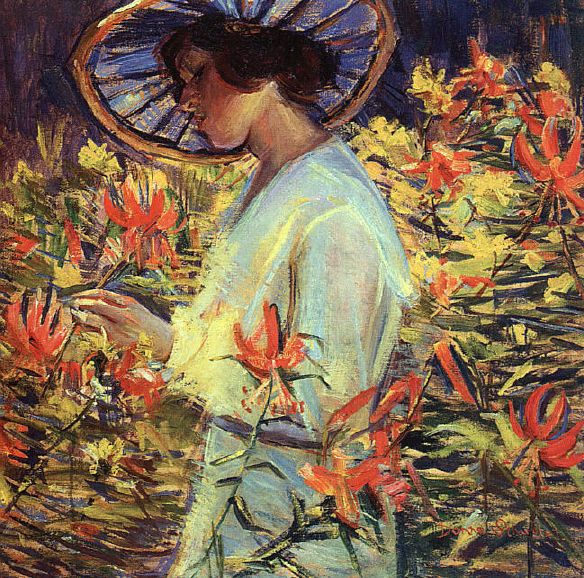
Donna Noreen Schuster
Tiger Lilies
ca. N.D.
During the 1920s and 1930s Schuster taught at the Otis Art Institute and was an organizer in the creation of several artists’ clubs and was a founder of The California Watercolor Society and a group that later became Women Painters of the West. Her subject matter included harbor scenes, landscapes, figure studies, and showed Cezanne's influence in her studies of water lilies in both oil and watercolor.  Indeed, her early works show the influence of Monet and Chase; however, after she studied with Stanton MacDonald-Wright, she later experimented with various modern idioms including Cubism and Abstract Expressionism.

Donna Noreen Schuster
Little Mother
ca. N.D.

Summers found Schuster at her small home in Laguna Beach where she spent her time painting and helped to establish the Laguna Beach Art Association. Her paintings recorded many areas of the Southern California landscape before it became the congested metropolis that it is, unfortunately, today.

During her early years, Schuster's art was exhibited at the Los Angeles County Museum of Art in the years 1914, 1917, 1920, 1927 and 1929. Later, in the 1930s, she had shows at the San Francisco Art Association, the New York Academy of Fine Art and the New York Water Color Society. In addition, Schuster exhibited with the California Watercolor Society from 1921 until the mid 1940's.

Tragically, in 1953, Schuster died, trapped inside her home as it was destroyed in a brush-fire.

Exhibitions:
Minnesota Artists, 1913 (gold medal); Blanchard Gallery (LA), 1914; LACMA, 1914, 1917, 1920, 1927, 1929; PPIE, 1915 (silver medal); Panama-Calif. Int'l Expo (San Diego), 1915 (silver medal); NW Exhibition (St Paul, MN), 1915 (silver medal); Calif. Art Club, 1915-33; SFAA, 1916; Woman’s Club (Hollywood), 1920, 1927; Calif. WC Society, 1921-42; Laguna Beach AA, 1924-30; LA County Fair, 1924, 1927; Friday Morning Club (LA), 1925; Ainslie Gallery (LA), 1926; Calif. State Fair, 1926; Bernay Gallery (LA), 1926; Artland Club (LA), 1927; Pasadena Art Inst., 1927; Ebell Club (LA), 1930; Artist’s Fiesta (LA), 1931; Palos Verdes Library, 1933; GGIE, 1939; Festival of Arts (Laguna Beach), 1949.

Collections:
LACMA; Downey (CA) Museum; Oakland Museum; Fleischer Museum (Scottsdale); Irvine (CA) Museum; Orange County (CA) Museum.

________________________________________________________
Sources
Edan Hughes, "Artists in California, 1786-1940"
American Art Annual 1913-33; Who's Who in American Art 1936-56; Southern California Artists (Nancy Moure); California Impressionism (Wm. Gerdts & Will South); Plein Air Painters (Ruth Westphal); Art of California, May 1991; Art in California (R. L. Bernier, 1916); Los Angeles Times, 1-3-1954 (obituary).


Friday, January 24, 2014

Culture, Time, and Passion...The Fibres of Art

WCCA Logo


Calling all Artists and Art Historians!


Warnborough College (my Alma mater) is holding its second annual Conference on the Arts in Canterbury, England this summer, beginning on the evening of August 18 through August 21, 2014. If you are able to attend, it promises to be a wonderful opportunity to meet and to collaborate with fellow art "folk."

Artists in all media, academics, archivists, historians, curators, guides, students, researchers, curriculum planners, policy makers, photographers, and professionals in the fields of media, education, arts, music, humanities, science, and social sciences, are encouraged to attend.

I am the Director of Round Table Discussions-please send me an abstract of your proposal for your paper. Hopefully, you will then present at the conference. I'll look for your abstracts at victoria@warnborough.edu

All additional information for the conference and submissions can be found at http://warnborough.org/

Join us for this exciting event!


Monday, January 13, 2014

Ila Mae McAfee: Taos Painter

Ila McAfee Oil Painting A Chain Reaction Trouble on the Trail
Ila Mae McAfee
A Chain Reaction: Trouble on the Trail
Oil on Canvas
ca. N.D.
 36 x 48 inches 
Ila Mae McAfee was born in 1897, in the small ranching community of Sargents, in southwestern Colorado near Gunnison. Her artistic interest began early and centered upon horses, which she would draw as a child. After she graduated from Gunnison High School in 1916, McAfee spent time in Los Angeles at the West Lake School of Art and the Haz Art School (1917-1918).
McAfee received her Bachelor's degree in art from Western State College, but her formal art education was at the aforementioned Haz Studio School in Los Angeles and at the Art Institute of Chicago. She decided to study under muralist James E. McBurney from whom she had taken courses in Chicago. McBurney hired McAfee as his assistant until 1924, after which she traveled to New York to study at the National Academy of Design and the Art Students League. While in New York, McAfee worked as an illustrator and a painter of miniatures and did illustrations for Blue Book, Ranch Romances and other magazines.

Ila Mae McAfee
Entrance to Spring
ca. N.D.
         Oil on canvas board
 16 x 20 inches
In 1926, McAfee returned to Colorado and married Elmer Page Turner, an artist she had met on her parent's Colorado ranch. She and Turner moved to Taos in 1928 to be a part of the burgeoning art movement of the region. There, they built White Horse Studio, which would serve as their studio and home until 1993.


Ila McAfee
New Mexico Desert
ca. 1930s,
Oil on board,
32 x 65 inches
 
 
Ila McAfee
Alert
ca. N. D.
Oil on canvas
20.25 x 28.25 inches
 
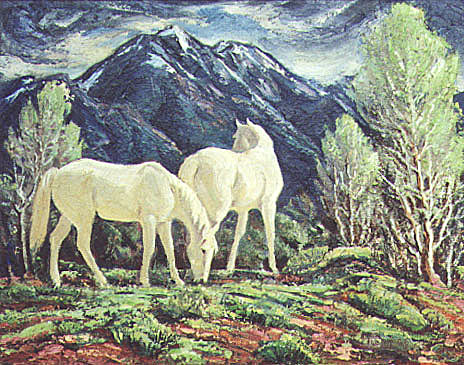
In Taos, McAfee painted landscapes and figures, but her specialty remained animals, specifically horses. She also worked as an illustrator of children's books. She worked on a number of murals, as well, though she was most famous during her lifetime for something entirely unrelated to her art; she owned a series of cats, all named Sanka, to whom she taught as many as seventy five tricks each.

 
Ila Mae McAfee
  Red Willows
    ca. N.D.
  Oil on canvas
  18 x 20 inches

In addition to over a thousand easel paintings, which are represented in numerous public and private collections, McAfee’s murals were placed in the post offices of Clifton, Texas, Cordell and Edmond, Oklahoma and Gunnison, Colorado, as well as in the public library of Greeley, Colorado. She was a  friend of the noted Western art collector, Lutcher Stark and painted fifteen portraits of Lutcher’s longhorns at "Shangri-La." She also received every award that could be won at the New Mexico State Fair professional juried show.
Ila McAfee Oil Painting Woman with Blanket
Ila Mae McAfee
Woman with Blanket
Oil on Panel
ca. 1950
8 x 10 inches


Ila McAfee Painting Horses in Rhythm
Ila Mae McAfee
Horses in Rhythm
Watercolor
ca. 1971
5  x 4 inches 

In Taos, she became known for her pueblo paintings and her depictions of horses and other animals as well as Native Americans, ranch scenes, and landscapes. During an interview for Southwestern Art 20, Rita Simmons asked about her first impressions of Taos. McAfee said, "[Taos] was so different then, the village was small and the Indians remained uninfluenced by the invaders. Once I asked one of them, "What did you call this country before the Europeans came?" 'Ours,' he told me."

In 1981, she was voted Taos Artist of the Year.  In addition, she worked as a WPA artist, completing a number of commissions for post office locations such as Edmond, Oklahoma, and Clifton, Texas.

Ila Mae McAfee lived a long, productive life that spanned nearly the entire twentieth century. She moved to Pueblo, Colorado in 1993, where she died two years later, after leaving her beloved adobe home in Taos, New Mexico.


_______________________________
Sources:
Taos and Santa Fe Painters, http://www.ilamcafeepaintings.com/, Retrieved January 10, 2014
http://www.askart.com/askart/m/ila_mae_mcafee/ila_mae_mcafee.aspx, Retrieved January 10, 2014
Kovinick, Phil and Marian Yoshiki-Kovinik, An Encyclopedia of Women Artists of the American West, (Austin: University of Texas Press), 1998, 208.
Rita Simmons, "Ila McAfee," Southwestern Art 20 (September 1990): 100.