Wednesday, April 20, 2016

Ruth Joy Hopkins: Painting "the bigness of it all"

Ruth Joy Hopkins (1891-1973) grew up in Fremont, Nebraska and began sketching as a young girl. While she was just in her teens, Ruth taught and painted regionally in a variety of towns in the state. She did not gain recognition for her work until years later, after she married painter Linton Hopkins in 1913 and settled in Casper, Wyoming in 1918. Ruth continued to work as an artist in the interim while raising a family, and in 1931 and 32, she attended the Broadmoor Art Academy in Colorado Springs. Soon after, she joined the art community in Casper and remained an important figure in the cultural life of Wyoming.
Ruth Joy Hopkins
Mountain Cabinn.d.
Etching
5 1/2 x 7 1/2 inches
Ruth Joy Hopkins
Church of the Transfigurationn.d.
Mixed Media
9 1/2 x 7 3/4 inches
As a child and teen, Ruth was interested in and created scenes of Nebraska. As a full-time resident of Casper until her husband's retirement in the early 1950s, she focused on the beauty of Wyoming. As she and her husband were both artists, they focused on themes in there and indicated an interested in "painting the story of Wyoming: the mountains, the sky, the sheep and sheep wagons, the bigness of it all." She produced canvases of Wyoming's landscapes, ranches, wildflowers, historic structures including a "Forts of Wyoming" series. Ruth also painted pioneer figures such as Jim Baker, Father Pierre DeSmet, and Captain Benjamin de Bonneville in her "Trail Blazer series. Her studies of Native Americans were distinctive as one, Arapaho Camp-Wyoming, hung at the National Association of Women Painters and Sculptors (NAWPS) in New York.

Ruth Joy Hopkins
Portrait of Caspar Collinsn.d.
Oil on canvas
Ruth Joy Hopkins
Mountain Cabinn.d.
Etching
5 x 4 inches
Hopkins and her husband spent summers from 1934 until the mid-1950s sketching in Mexico and, in 1956, she studied art at the Escuela Belle Artes in Morelia there. Three years later, she and Linton hung their work, paintings of Mexico at the Casper Fine Arts Club. Ruth exhibited widely at such galleries and museums as the Argent Galleries in New York, Joslyn Memorial Museum in Omaha, NE, the Wyoming State Fair, Casper and Midland colleges, and the Governor's Exhibition in Omaha. One-person shows include the Wyoming Art Association and University of Wyoming in Laramie and the Denver Art Museum.

Ruth Joy Hopkins
Goose Egg Ranchn.d.
Watercolor
5 1/2 x 7 1/2 inches
Work created during her last years spent in Fremont is seen in the collections of Holdredge Museum, Nebraska, Wyoming State Capitol, Cheyenne, Fort Casper Museum, Wyoming, and Kansas State College, Pittsburg.

Sources__________________________________________________________________________
An Encyclopedia of Women Artists of the American West, Phil Kovinick and Marian Yoshiki-Kovinick, University of Texas Press, Austin, 1998, p. 148.
The Oregon Trail Crossing: Western Art for your Lodge, http://www.oregontrailcrossing.com/Western_Art.html, retrieved April 20, 2016.
The WPA Guide to Wyoming, The Cowboy State, Federal Writers Project, 1940, no page number.

Wednesday, March 16, 2016

Mary H. Teasdel: Prolific Artist but...Where is Her Work?

Mary H. Teasdel
1863-1937
One of the most frustrating aspects of doing the research and writing a blog about early American female artists is the lack images available of their work. Mary Teasdel is the perfect example of a well-known, respected artist who studied abroad, exhibited in both Europe and the United States, and whose work hangs in museums and in the state capitol in Utah, her home state. Locating more than just a few of her pieces, however, is nearly impossible. I present to you a fascinating, driven artist with just a few examples of her work.

Mary Teasdel, daughter of a successful merchant, was born and grew up in Salt Lake City. An important and active impressionist painter, she was one of the first women from Utah to study in Paris. 
Teasdel took music lessons, was provided the best schooling available, and lived in a large and comfortable home in Salt Lake City. She attended the University of Deseret from 1882 until 1886 where she studied under painter, George Ottinger. At the age of 23, Teasdel graduated with honors and continued her studies with painter, J. T. Harwood. Teasdel, along with her friend Cora Cooper, traveled to New York to study drawing and painting at the National Academy of Design. 

Mary H. Teasdel
Springtime
ca. 1922
Oil on academy board
9 x 11.75 inchesUtah Museum of Fine Arts
Upon her return home to Utah, she found her family had fallen on severe financial times which appeared to prevent Mary's dream of becoming a professional artist. However with the money she had saved and an inheritance from one of her brothers, Mary was able to travel to Paris to study art. Early in 1899, Teasdel and two close artist friends, Lara Rawlins (later Chairman) and May Jennings (later Farlow), studied in France for three years where William Benjamin-Constant, Jules Simon, and James Whistler were her instructors. She also spent summers sketching and painting in Normandy.
Mary H. Teasdel
A Summer Bouquet
ca. n.d.
Watercolor
21 x 17.5 inches
Teasdel's work was exhibited at the Paris Salon in 1899—the first woman and second Utah artist to receive this honor. She exhibited at the International French Exhibition in 1900. When she returned again to Utah in 1902, she was immediately appointed by Governor Wells to the governing board of the Utah Art Institute, and became involved in a number of statewide and Salt Lake City cultural activities. Teasdel was an art instructor in the Salt Lake City school system as well as in her private studio within her residence.
Mary H. Teasdel
Mother and Child
ca. 1920
Oil on canvas
30.5 x 24.5 inches
State Fine Arts Collection, Salt Lake City, Utah
In 1920, Teasdel lived briefly in Carmel California before moving to Los Angeles the following year. During her years in Los Angeles and, until her death, she was active with the California Art Club and the Women Painters of the West. In addition, she frequented the Monterrey Peninsula and sketched in other scenic spots around our beautiful state.
Mary H. Teasdel
Seascape
ca. n.d.
Oil on canvas
30.5 x 24.5 inchesJ. Willard Marriott Library, University of Utah
Teasdel, known as Utah's Mary Cassatt, was one of the most interesting and talented Utah artists ever to study in Paris. As Robert Olpin, Utah Art Historian commented, “she was a more flamboyant brush handler than (her instructor) J.T. Harwood. A subtle colorist she would in fact demonstrate an increased love of the “painterly approach“ in many later landscape and still life scenes. Also a portraitist, Teasdel was proficient in oils, watercolor, and pastels. Her artistic eye was often combined with her other skills within interior design and eventually, she became the designer of several residential locations accentuated by her own painted work. Teasdel's inclination toward the decorative arts frequently inspired her choice of attitude toward the pictorial subject matter she treated.
Mary H. Teasdel
Untitled Seascape
ca. n.d.
Watercolor
7 x 10 inchesUtah Museum of Fine Arts
In 1908, Teasdel received the top prize at the Utah State Fair, a first for a woman. She won other local awards during the following years and displayed works at the Springville Museum of Art in Utah and the annual exhibition in Heyburn, Idaho. She had a one-woman exhibition at the Gallery of Alice Horne in Salt Lake City in 1932. Her work hands in the Smithfield Library, Museum of Art, the State Capitol, the University of Utah and the Utah State Institute of Fine Arts.
Sources__________________________________________________________________________
Mary H. Teasdel, Springville Museum of Art, http://www.springvilleartmuseum.org/collections/browse.html?x=artist&artist_id=643 (retrieved March 16, 2016.
Deseret News, Art Historian Robert S. Olpin Dies, http://www.deseretnews.com/article/635159268/Art-historian-Robert-S-Olpin-dies.html?pg=all, (retrieved March 17, 2016).
Utah Artists Project: J. Willard Marriott Library, Mary H. Teasdel, http://www.lib.utah.edu/collections/utah-artists/UAP-Mary-Teasdel.php, (retrieved March 17, 2016).
An Encyclopedia of Women Artists of the American West, Phil Kovinick and Marian Yoshiki- Kovinick, University of Texas Press, Austin,1998, p. 298-299. 


Thursday, February 4, 2016

Blanche Chloe Grant: Painter, Muralist, and Historian


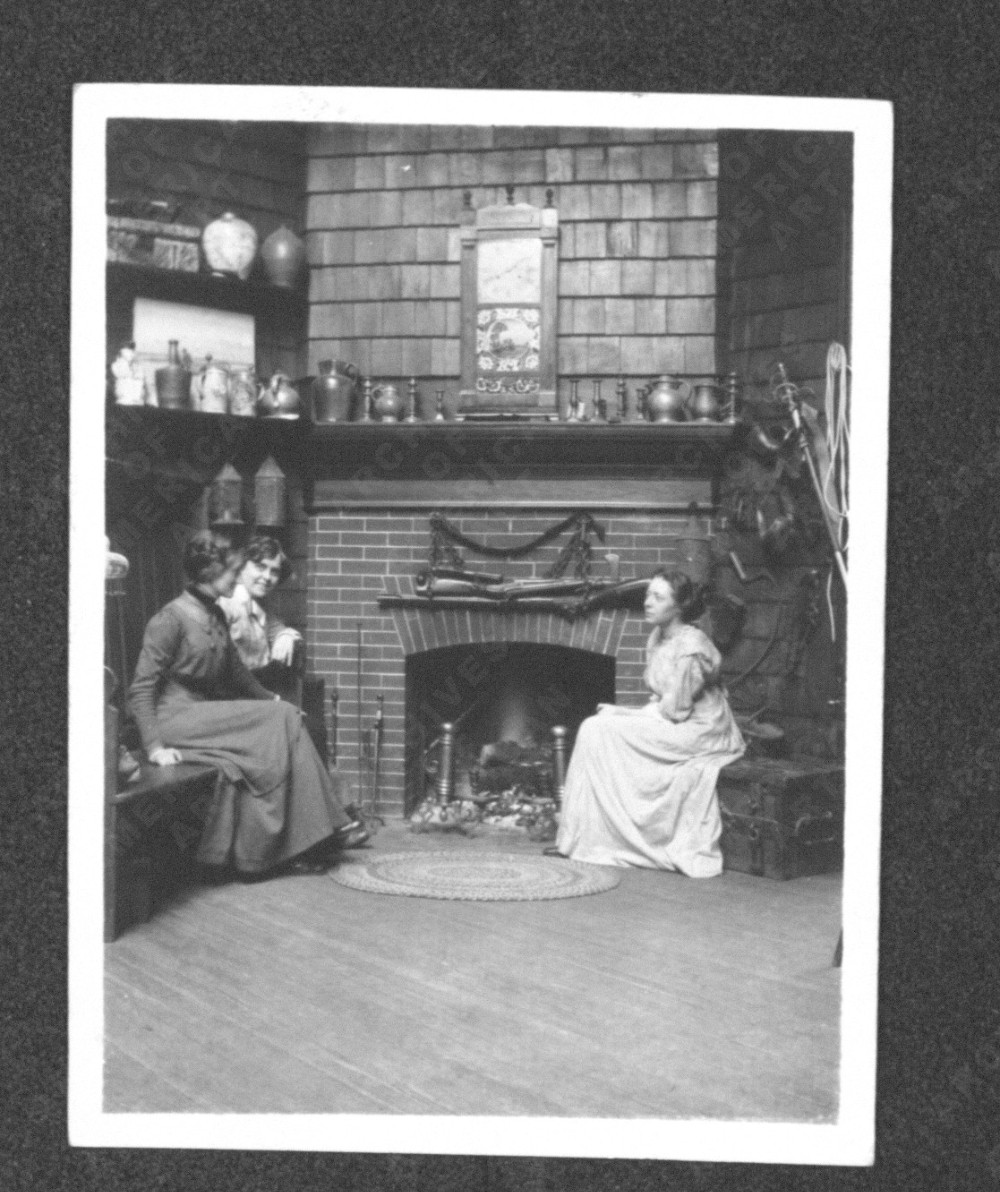
Olive Rush, Blanche C. Grant, and Edith Pennewill in Howard Pyle's Studio
ca 1911
New York, New York
Blanche Chloe Grant was Born in Leavenworth Kansas and grew up in Indianapolis. She graduated from Indianapolis High School, where her father was principal, and went on to attend Vassar College in New York. Grant did not take any art classes at Vassar due to her parent's stern Victorian attitudes. Determined to be an artist, later, while living in Bridegwater and Tauton, Massachusetts, Grant studied with Francis Mortimer Lamb, then went on to the School of the Boston Museum of Fine Arts (1906-1908), followed by study at PAFA, the Pennsylvania Academy of Fine Arts, Philadelphia. Her study at the Art Students League in New York with Howard Pyle and Frank Noyes resulted in her association as an artist in Pyle's circle working in Wilmington, Delaware and, by 1914, she was working as a magazine illustrator and landscape painter. She established a studio in New York.

Blanche Chloe Grant
Indian Tales, Taos
ca 1922
Oil on canvas
In 1916, Grant accepted an associate professorship in the art department of the University of Nebraska, Lincoln and held the position until 1920 with a short break as a YMCA secretary in Le Mans, France. During a vacation, Grant traveled to New Mexico and fell in love with the art colony Taos. She decided to stay and became one of the community's most active members. In 1922, Grant served as editor of the Taos Valley News and in time became a leading historian and ethnologist of the region. She lectured often and wrote several important books on Taos including When Trails Were New: The Story of Taos, 1934. 

Blanche Chloe Grant
ca 1934
Southwest Heritage Series
Sunstone Press
Reluctant to share information with strangers and determined to maintain their traditional way of life, the Taos Indians chose not to speak with strangers about their culture. They were willing to communicate with people they knew and trusted to properly share their stories and Grant was one. She assured the Taos Indians that the written word would be a source of information for their descendants and a permanent accounting of their lives for future generations.

Blanche Chloe Grant
ca 1925 (original)
Southwest Heritage Series
Rio Grande Press
<i>Taos Indian with Bowl</i>
Oil on canvas
18 x 22 inches
Signed: lower right
Blanche Chloe GrantTaos Indian with Bowl
ca n.d.
Oil on canvas
18 x 22 inches
Grant was active in Taos as a painter, muralist, and etcher and was also a member of the local art association. She painted portraits of Kit Carson, the frontier scout, and Lewis A. Garrand, Taos pioneer and author. She also painted Native Americans, pueblo life, New Mexico landscapes and exhibited widely.
Treadway Gallery Fine Paintings sales leader
Blanche Chloe Grant
Touch-Me-Not Mountain, Ute Park, New Mexico
ca 1928
Oil on board
20 x 16 inches
Faith
Blanch Chloe Grant
Faith
n.d.
Oil on canvas
24 1/4 x 33 inches

Her work can be found in the collections of the County Courthouse and Harwood Foundation in Taos and in the Southwest Museum in Los Angeles. 

Sources______________________________________________________________________
An Encyclopedia of Women Artists of the American West, Phil Kovinick and Marian Yoshiki-Kovinick, University of Texas Press, Austin, 1998, p. 116.
AskArt, http://www.askart.com/artist/Blanche_Chloe_Grant/5811/Blanche_Chloe_Grant.aspx, retrieved February 4, 2016.
Zaplin-Lampert Gallery, http://www.zaplinlampert.com/category/blanche-chloe-grant.html, retrieved February 4, 2016.
artnet, http://www.artnet.com/artists/blanche-chloe-grant/indian-tales-taos-SK1C1N5HHl-IZHdSoImxlQ2, retrieved February 4, 2016.

Thursday, December 17, 2015

Z. Vanessa Helder: Early Northwest Modernist

Z. Vanessa Helder (Paterson)
1904-1968
Zama Vanessa Helder was an American watercolor painter who gained national attention in the 1930s and 40s, primarily for her scenes in Eastern Washington. She painted with a bold, Precisionist style not commonly associated with watercolor, rendering landscapes, industrial scenes, and houses with a Magic Realist touch (an American style with Surrealist overtones) that gave the pieces a forlorn, isolated quality, somewhat in the manner of Charles Sheeler and Edward Hopper. I love her dynamic style!
For a number of years,  Helder's work was out of vogue and largely forgotten by the public, but the power of her artwork has gradually been rediscovered, particularly in the Pacific Northwest. The Tacoma Art Museum held an exhibition of her work in 2013, and the Northwest Museum of Art and Culture in Spokane has her twenty-two piece series relating to the construction of the Grand Coulee Dam - generally considered her masterwork - in its permanent collection.
Born in the town of Lynden near Bellingham, Washington, her somewhat eccentric family had an artistic bent whose interests included music, theosophy and astrology, Helder was an unconventional figure often found strolling Seattle's streets dressed in her finest attire with "Sniffy," her pet skunk in tow. She kept an unorthodox array of pets throughout her life (at one time making inquiries with various state agencies to find out if she could legally own a flying squirrel). 
Portrait of Blanche Luzader Morgan (Losey)
Z. Vanessa Helder
ca. 1939
Oil on masonite
Private collection
Her mother, passionate about art, gave Helder her first painting lessons at a young age and, eventually, she studied at the University of Washington. After graduation, Helder established herself as a well-known local watercolorist in the area. In 1934, she received a scholarship to the Art Students League in New York and studied with artist/educators Frank Vincent DuMond, George Picken, and Robert Brackman. During this time, Helder's work became more refined and she began to experiment with other mediums such as oil and lithogrpahy. In 1935, Helder was elected to the National Association of Women Painters and Sculptors club and in 1937, received a solo exhibition at the Grant Studios in New York. In addition, she won membership in the American Watercolor Society in 1943. 
Sand and Gravel Works Z. Vanessa Helder
ca. 1939-1941
Watercolor
After she moved back to the Pacific Northwest after her studies in New York, Helder became a member of the Women Painters of Washington (WPW) an organization created to provide an opportunity for women to network and overcome obstacles faced by women artists in the male-dominated art world. WPW is still active and lively-information about the organization, membership, and exhibitions can be found at http://www.womenpainters.com/. 
Hallett House, Medical Lake Z. Vanessa Helder
ca. n.d.
Watercolor
When the Federal Art Projects began in 1933, members of the WPW became involved. The projects continued under the Works Progress Administration, established by President Franklin D. Roosevelt in 1939. Helder created a striking series of watercolors depicting the construction of the Grand Coulee Dam executed between 1939 and 1940.
Grand Coulee Dam Z. Vanessa Helder
ca. 1940
Watercolor
After relocating back to Seattle in 1941, Helder married industrial architect Robert J.S. "Jack" Paterson. Following the attack on Pearl Harbor, she joined the Washington State Artists Council for Defense. Helder continued exhibiting locally and nationally, and in 1943, reached a high point in her career when several of her works were selected for inclusion in American Realists and Magic Realists, a major exhibition at the Museum of Modern Art (MoMA) in New York. 
Sea Shells - Blue and Gold Z. Vanessa Helder
ca. 1942
Watercolor
In 1943, Helder followed her husband, Robert Paterson, to Los Angeles as he pursued professional opportunities and joined the board of the California Watercolor Society while she continued to exhibit old and new works in California, Washington, and New York,. She also maintained an active involvement in the Los Angeles art associations that were the primary exhibitors of California artists at that time. Of course, art evolves and tastes change. While Helder made an attempt to keep pace with the post-war developments happening in the art world, she was squeezed out of the New York galleries by Abstract Expressionism which began to take precedence in painting while watercolor fell out of favor. 
Near San Jacinto Z. Vanessa Helder
ca. n.d.
Watercolor
Helder lived in Los Angeles for 25 years and worked as an instructor at the Los Angeles Art Institute from 1952-1955. Over time, Helder exhibited less regularly and as a result of poor health, she passed away on May 1, 1968, just one week after her husband's death.
Her art estate was bequeathed to the Westside Jewish Community Center in Los Angeles, a puzzling decision since she herself was not Jewish. The center sold the remaining works from her estate in several sales over the ensuing years, unfortunately with no record of the buyers. Of the hundreds of artworks Helder made over her lifetime, the majority remain missing -- to this day. 
Exhibitions/Collections
Museum of Modern Art, the Whitney Museum, the Metropolitan Museum of Art, the Denver Art Art Museum, Seattle Art Museum, collections at the National Museum of American Art, Smithsonian Institution, the Newark Museum, the High Museum of Art, the Portland Art Museum, Portalnd Oregon, the Philadelphia Museum of Art, the St. Louis Art Museum, the Academy of Arts and letters, Washington State University, I.B.M Corporation, the Northwest Museum of Arts and Culture, and the Whatcom Museum of History & Art.
Sources___________________________________________________________________
  1. An Enduring Legacy: Women Painters of Washington, 1930-2005, Whatcom Museum of History & Art, Bellingham Washington, University of Washington Press, Seattle, 2005, pp 74-77.
  2. George Stern Fine Arts, Z. Vanessa Helder, http://www.sternfinearts.com/zvahe119.html, retrieved December 17, 2015.
  3. HistoryLink.org, Women Painters of Washington, Essay 7644, http://www.historylink.org/index.cfm?DisplayPage=output.cfm&File_Id=7644, retrieved December 17, 2015.
  4. Independent Spirits: Women Painters of the American West, 1890-1945, ed. Patricia Trenton, University of California Press, Berkeley and Los Angeles, 1995, p. 120.
  5. An Encyclopedia of Women Artists of the American West, Phil Kovinick and Marian Yoshiki-Kovinick, University of Texas Press, Austin, 1998, p. 135.


Friday, December 4, 2015

Kathleen Blackshear: Treating her subjects with Humility and Grace

Kathleen Blackshear
Unknown Photographer
Kathleen Blackshear was born in the Texas cotton belt. She grew up spending summers on the nearby cotton plantations of both her maternal and paternal families close to Navasota, a town founded by her grandfather. It was there that she became friends with the children of the African Americans who picked cotton for her family-an experience that would have great significance in her later career, both as an artist and teacher. She began to study art at age 12. The first woman in her town to wear trousers, Blackshear bucked convention her whole life. She earned a bachelor’s degree in modern languages from Baylor University in Waco in 1917 and studied at the Art Students League in New York, where her teachers included Solon Borglum, George Bridgeman, and Frank Vincent DuMond. In 1918, she left New York and spent the next six years travelling and exploring career options in Los Angeles, where she got a job creating posters for films. She also found work in Culver City coloring films in the days before Technicolor, and when every transparency had to be hand-colored under a magnifying glass. Blackshear also explored New Orleans, Europe, and Mexico, continuing to produce photographs, prints, paintings, and sculpture.
Blackshear moved to Chicago in 1924, where she attended the School of the Art Institute of Chicago (SAIC) to study painting and graphic arts. She was inspired by the art history class taught by Helen Gardner in which she enrolled in 1925. Gardner became mentor and inspiration to Blackshear, and they formed a close relationship which lasted until Gardner's death in 1946. Blackshear began teaching art history in 1926, continuing until her retirement in 1961. Like Gardner—whose widely used textbooks, Art Through the Ages (1926) and Understanding the Arts (1932) which she illustrated—Blackshear introduced modernist ideas in her courses. She did not teach the standard history of classical through Renaissance art, but included a wide variety of non-western, pre-Renaissance, and progressive, twentieth-century art in her classes as well. She sent students to explore not just the galleries of the Art Institute, but the Field Museum of Natural History, the Shedd Aquarium, the Oriental Institute, and the Bronx Zoo for inspiration. In this way, Blackshear influenced generations of students at SAIC to discover idiosyncratic sources and connections with cultures other than their own, laying the groundwork for later Chicago artists of the Monster Roster and Imagist movement. Blackshear was particularly influential in inspiring and supporting the careers of the African American students in her classes, such as Margaret Burroughs. She also made two dioramas for the 1933 Century of Progress Exposition in Chicago, and illustrated Art Has Many Faces by Katherine Kuh. Blackshear emphasized the aesthetic over the historical in teaching art history.
Kathleen Blackshear
Untitled (Woman Mopping)
ca 1930s
Lithograph
Blackshear frequently depicted African Americans, inspired by her summer visits to Texas and her childhood memories but also by her experiences in Chicago. Her lithograph,Untitled (Woman mopping) sympathetically depicts a sturdy washerwoman mopping, in a generalized style typical of the American Scene and regionalist styles of the Depression era. Blackshear renders her head at an unnatural angle as if to emphasize the backbreaking work, and her heavy, bulky form suggests that she has and will continue to spend hours performing this monotonous task. It exemplifies why critic C. J. Bulliet called her “Chicago’s most sympathetic, most understanding painter of the American Negro” in 1939. Bulliet continued: “Her Negroes in these slight but expert drawings live and breathe a happy, wholesome life,” though he was quick to qualify that she was not a Communist recruiter.
 From 1924 to 1940, Blackshear returned to Navasota to visit her mother at Christmas as during these visits, she often depicted the small-town Texas ritual of Saturday shopping. Her familiarity with her subjects enhanced her sensitivity and understanding of a "simpler world where eloquent compassion was adequate for commenting on racial issues and clean form was remarkably effective in communicating art values."
A Boy Named Alligator demonstrates her interest in storytelling found in much Regionalism of the time and the painting's interest lies not in the narrative, but in its bold, simplified forms and rhythmic patterns of the land.
Kathleen Blackshear
A Boy named Alligator
ca 1930
22 1/8 x 18 1/8 inches
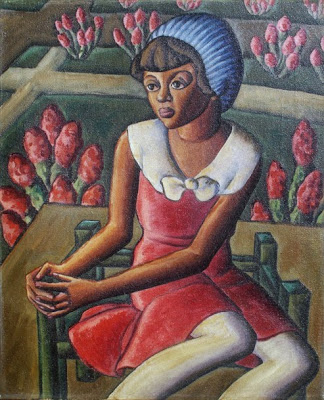
Kathleen Blackshear
Ruby Lee and Loula May Washington
ca 1932
Oil on canvas
In her best works, Blackshear captures her subjects with simple grace and humanity without sentimentality or cliche. In her painting, Ruby Lee and Lula May Washington, she paints a dual portrait where the wood grain provides and intriguing visual backdrop.
Blackshear maintained a studio in Houston and spent many summers at her home in Navasota, After her retirement in 1961, Kathleen Blackshear returned to Navasota with her companion, Ethel Spears, and continued to lecture on art at museums and schools throughout Texas until the early 1970s. She received the title Professor Emeritus from the School of the Art Institute of Chicago in 1968. She died on October 14, 1988 in Navasota where she is buried in Oakland Cemetery.
Blackshear’s work was exhibited at the Art Institute of Chicago, Chicago Society or Artists; Witte Memorial Museum, San Antonio, TX; Museum of Fine Arts, Houston; Museum of Fine Arts, Dallas; among others. Her works also are held in the Art Institute of Chicago.
Kathleen Blackshear
Title Unknown
ca 1930s
Oil on canvas

Sources______________________________________________________________________
  1. Bulliet, C. J. “Artists of Chicago Past and Present: No. 97: Kathleen Blackshear.” Chicago Daily News, July 29, 1939.
  2. Illinois Women Artists Project, http://iwa.bradley.edu/?q=artists/KathleenBlackshear.
  3. Kovinick, Phil, and Marian Yoshiki-Kovinick. An Encyclopedia of Women Artists of the American West. Austin: University of Texas Press, 1998.
  4. Landauer, Susan, and Becky Reese. “Lone Star Spirits.” In Patricia Trenton, ed. Independent Spirits: Women Painters of the American West, 1890–1945, 199–200. Los Angeles: University of California Press, 1995.
  5. Tormollan, Carole. A Tribute to Kathleen Blackshear. Chicago: School of the Art Institute of Chicago, 1990.
  6. Tormollan, Carole. “Kathleen Blackshear.” In Women Building Chicago: 1790-1990, edited by Rima Lunin Schultz and Adele Hast, 84–86. Bloomington: Indiana University Press, 2001.
  7. Weininger, Susan. “Kathleen Blackshear.” In Elizabeth Kennedy, ed. Chicago Modern, 1893–1945: Pursuit of the New, 92. Exh. cat. Chicago: Terra Foundation for the Arts, 2004.
  8. Yochim, Louise Dunn. Role and Impact: The Chicago Society of Artists, 222. Chicago: Chicago Society of Artists, 1979.

Tuesday, November 24, 2015

June Wayne: Pushing Boundaries, Bending Definitions

June Wayne
Photo: Niku Kashef
An artist and art historian, I had heard of, but was not really familiar with June Wayne's life or her artwork. Considering her body of work and renown it seems impossible to have missed that enormous talent and contribution to the world of art throughout the twentieth century but...I did. Wayne was a true Renaissance "Woman." She was a print-maker, painter, tapestry creator, author, filmmaker, educational TV star, lecturer, administrator, feminist thinker and activist-whew! 

Born in Chicago in 1918, as June Claire Kline, she quit high school at 15 years old to become an artist and had her first solo show-a series of abstract pointillist paintings-in the city at the Boulevard Gallery in 1935. On the strength of that show, she was invited to Mexico City by the Department of Education to create and install an exhibition in the Ministry of Public Administration alongside the works of Diego Rivera at the Palacio de Bellas Artes. 

June Wayne
Waiting for Newspapers
ca 1936
Oil on canvas
Wayne returned to Chicago in 1935 to work with the Works Progress Administration (WPA) as an easel project artist and continued to paint in the Social Realist style. By 1939, she landed in New York, where she would continue to paint while supporting herself making jewelry, as an industrial designer creating buttons and notions in the garment district, and as a production illustrator and staff writer for radio, bouncing between New York and Los Angeles.

June Wayne
Cryptic Creatures
Kafka Series
ca 1948
Oil on Canvas
36 x 30 inches
With the United States entry into World War II, Wayne moved to Los Angeles with the intention of working in the aircraft industry. She took classes in production illustration run by CalTech and Art Center but returned to Chicago to work for radio station WGN. 

As I explored opportunities for women during the early years of the twentieth century in my doctoral thesis, Wayne's experiences seemed to further prove it was difficult for female artists to work independently and to exhibit their work. She recalled in an interview with Betty Hoag, "...in those days one of the reasons it was easy to get on the project is that government really didn't take seriously that any art was going to come out of it. It was "made" work in which categories of people got jobs, but nobody really took the job seriously."

Despite the limitations of the era, Wayne painted and explored, refining her technique in lithography, the process of printing from a plane surface (as a smooth stone or metal plate) on which the image to be printed is ink-receptive and the blank area ink-repellent.

After the war, in 1945, Wayne settled permanently in Los Angeles. She incorporated techniques she learned at CalTech and developed a body of work that anticipated POP and OP art incorporating invented images suggesting nuclear fission and the atom bomb. Wayne produced a series of lithographs -- the Kafka Series and the Justice Series. She was ready to embark on the next body of work, a collection based on the poems of John Donne. Erotic in nature, her California printer balked and, frustrated, Wayne looked to other options. En route to Paris to work with the renowned printer Marcel Durassier, at a layover in New York she met Mac Lowry of the Ford Foundation. Irked by the lack of creative collaborative support available to artists in the States, Wayne asserted her feelings. Intrigued, Lowry asked her to keep in touch. "I remember saying to him: No wonder Picasso was so prolific. Anything he wanted to do, there was an army of craftsmen to fabricate it or him.They had a tradition of collaborative practices. We don't have that here."

June Wayne
The Final Jury
Justice Series
ca 1954
Lithograph
June Wayne Collection, Louis Stern Fine Arts

During the 1950s, Wayne exhibited in major shows at museums in Southern California including and in San Francisco at the De Young Museum of Art, California Palace of the Legion of Honor, and the San Francisco Museum of Art. She also showed her work at the Art Institute of Chicago and the Philadelphia Art Alliance. She set out to revive the art of lithography and created a plan of the Tamarind Lithography Workshop, a place where a pool of master printers would be trained and collaboration of artists would be encouraged. Under her direct supervision and administration, over 300 printers were trained and virtually all the major print workshops in America today trace their roots back to Tamarind.
June Wayne
Grande Vague Noire (Black Tidal Wave)
ca 1973
Woven at Atelier de Saint Cyr
Her tapestry era began with travel to France to work with master weavers in translating her pieces into tapestries. She felt the weaving with its rhythmical, slow, technique created an appropriate way by which she could transmit to the viewer a sense of time passing that is integral to the process. 

June Wayne
Delegate Dorothy from The Dorothy Series
 ca 1977
Color lithograph printed by Edward Hamilton.
In the late 70s Wayne created The Dorothy Series, a traveling exhibition of 20 lithographs, accompanied by a video presentation that appeared in museums across the country. The combination of ephemeral-sequential imagery of narrative in collage from letters, documents, newspaper clippings, and old photographs that narrated the life of her mother, a traveling corset saleswoman. 

Wayne was also involved in the feminist art movement in Los Angeles in the 70s.  Her biggest contribution to the movement was in education, as Wayne taught a series of professionalization seminars entitled "Joan of Art" to young women artists beginning around 1971. Wayne's seminars covered various topics related to being a professional artist, such as pricing work and approaching galleries, and involved role-playing and discussion sessions. They also encouraged giving back to the feminist community since graduates of Wayne's seminars were required to then teach the seminars to other women. Wayne, along with fellow artists Shelia Levrant de Bretteville, and Ruth Weisberg founded the Los Angeles Council of Women in the Arts which sought the equal representation of women artists in museum exhibitions. In addition, Wayne was also part of the selection committee for the exhibition Contemporary Issues: Works on Paper by Women, which opened at the Los Angeles Woman's Building in 1977, featuring the works of over 200 women artists.

"Wayne's uniqueness lies precisely in her departures," then-Times art critic William Wilson wrote in 1998. "She offers a fruitful alternative model for the artist. Never allowing a signature style to imprison her, like a creative scientist she investigates her ideals and passions even when they lead her out of the studio. She does more than make superior art in Los Angeles. She helped mold its larger culture."
June Wayne
Tenth Wave
ca 1972
Lithograph
June Wayne Collection, Louis Stern Fine Arts
Wayne never reached the prominence as an artist some said she deserved. Experts offered several reasons for her limited recognition. "She has not fallen into any of the art movements that have had such publicity," Los Angeles County Museum of Art curator Victor Carlson said when a retrospective of Wayne's work opened in L.A. in 1998. He mentioned Pop Art, Abstract Expressionism and Color Field painting. "None of those brackets explain her," he said. "I think that a lot of critics have not known what to make of her."
June Wayne
Anki
Cognito Series
ca 1984
Acrylic and silver leaf on paper marouflaged onto canvas
with gesso and gelatin
72 x 54 inches
Wayne's art has been exhibited all over the world and is part of several museum collections, including the National Museum of Women in the Arts, the Norton Simon Museum, the Museum of Modern Art, and the Los Angeles County Museum of Art. She has been awarded honorary doctorates from the Rhode Island School of Design, Moore College of Art and Design, California College of Arts and Crafts, and The Atlanta College of Fine Arts.

In 2002, Wayne became a research professor at the Rutgers Center for Innovative Print and Paper. Wayne also donated a group of over 3,300 prints, both her work and the work of other artists, to the Rutgers Center for Innovative Print and Paper, which established the June Wayne Study Center and Archives to house the collection.

Wayne passed away at her Tamarind Avenue studio in Hollywood, CA on August 23, 2011 with her daughter and granddaughter by her side.
_____________________________________________________________________________
HYPERALLERGIC, Alicia Eler, June Wayne's Farewell, June 23, 2014, http://hyperallergic.com/129722/june-waynes-farewell/, retrieved November 24, 2015
The Creative Cosmos of June Wayne, Lynell George, KCET, Artbound, http://www.kcet.org/arts/artbound/counties/los-angeles/june-wayne-pasadena-museum-of-california-art.html, retrieved November 24, 2015.
Yesterday and Tomorrow: California Women Artists, Sylvia Moore, ed., Midmarch Arts Books, New York, 1989, p. 15-159.
The New York Times, June Wayne, Painter and Printmaker dies at 93, William Grimes, August 22, 2011. http://www.nytimes.com/2011/08/28/arts/june-wayne-painter-and-printmaker-dies-at-93.html?_r=0
The Los Angeles Times, June Wayne dies at 93; led revival of fine-art print making, Mary Rourke, August 25, 2011,
http://articles.latimes.com/2011/aug/25/local/la-me-june-wayne-20110825, retrieved November 24, 2015.
The June Wayne Collection, http://www.junewayne.com/about.php, retrieved November 24, 2015.