Thursday, November 7, 2013

Sarah Ladd-Pioneering Portland Photographer

By the turn of the twentieth-century, the visual arts became an established part of Pacific Northwest culture. Artists worked and lived there. The wealthy, whose money came from banking, law, timber, and railroads, began collecting European, Asian, and some American painting, prints, and sculpture. Artists and supporters began to form organizations to exhibit art, some of which was on loan and shown expressly for the purpose of enhancing the cultural sophistication of the community. Instruction in the arts became available. Early local magazines such as The Westerner and The Week-End, covered the arts and the visual arts. And, more important to this researcher, local female artists were featured in The Westerner magazine.

The 1909 Alaska-Yukon-Pacific Exposition's exhibitions of international, national and local artists brought art to everyone. During this twenty-year time period, from 1890 until 1910, the expansion of railroad service to the Puget Sound region (Northern Pacific Railroad to Tacoma in 1885 and Great Northern Railroad to Seattle in 1893) and the discovery of gold in Alaska/Yukon,1896, resulted in a tremendous population boom. The influx into this stunning region brought artists (and people whose children would become artists), patrons, art appreciators, writers about art, and art educators.

File:SarahLadd-EarlyMorning.jpg
Sarah H. Ladd
Early Morning above Vancouver
 Published in Pacific Monthly, Volume 14 No 1, 1905
 

Sarah Hall Ladd (13 April 1860 – 30 March 1927) was an early 20th-century American pictorial and landscape photographer. Ladd was born Sarah L. Hall in Somerville, Massachusetts, the daughter of John Gill Hall and Sarah Cushing. Little is known about her childhood. In 1881, Ladd relocated to Portland with her new husband, Charles, the son of leading Portland businessman William S. Ladd. The couple settled in a home that overlooked the Willamette River and began a comfortable life together.

It is not known or documented precisely when Ladd developed an interest in photography, but sources claim she joined the Oregon Camera Club in September 1899, and, by early 1901, a number of her works were on exhibition in San Francisco. In 1903, New York photographer Alfred Stieglitz formed Photo-Secession, an early-20th century movement that strove to elevate photography as a fine art. The group never numbered more than 105 members and were from various cities across the United States. Sarah Hall Ladd, Gertrude Käsebier, Edward Steichen, Clarence H. White, and Lily E. White were included among the select membership.

Sarah H. Ladd
Gateway to the Inland Empire
ca 1903
Oregon Experience "The River they Saw"

 
In 1903, the adventurous Ladd and White began to take extended trips on the Columbia River on White’s custom-built houseboat, the Raysark, a vessel that contained a darkroom. Both women excelled at photography and became internationally known for their pictorialist-style landscapes of the Columbia Gorge filled with soft light, clouds and atmosphere. Their photographs illustrated travel brochures and magazines helping draw tourism to the area.  

Sarah H. Ladd
Submerged Forest
ca 1902-1904
Oregon Historical Society


Ladd took this photograph of the “submerged forest” on the Columbia River between 1902-1904. The remains of trees in the river are found 25 miles above Cascade Rapids. Most of this area is now submerged behind Bonneville Dam, 40 miles east of Portland. In those days, travel was a challenge as roads were not paved and the terrain was unfriendly to motorized vehicles.

By 1904, Ladd’s social and familial responsibilities kept her away from her photography. She was invaluable to her husband when he became part of the preparations for Portland’s 1905 Lewis and Clark Exposition. In 1910, the Ladds moved to the town of Carlton, Oregon, after Charles became president of the Carlton Consolidated Lumber Company. In spite of these additional obligations, however, Ladd managed to exhibit fourteen photographs at the 1915 Panama-Pacific International Exposition in San Francisco.

Ladd became a prominent member in the Christian Science movement beginning in 1911. After Ladd’s husband died in 1920, she moved to Carmel, California in late 1924 to join her long-time friend, Lily White. Ladd lived in Carmel for the rest of her life. She died there on March 30, 1927.

________________________________________________________

Further reading:

James V. Hillegas, Oregon Historical Society, Oregon History Project, http://www.ohs.org/education/oregonhistory/index.cfm.

 Carole Glauber, “Eyes of the Earth: Lily White, Sarah Ladd, and the Oregon Camera Club,” Oregon Historical Quarterly 108:1 (Spring 2007), 34-69.

Richard L. Hill, “Science-Landslide Sleuths,” Oregonian May 15, 2002.

Jim E. O’Connor, “The Evolving Landscape of the Columbia River Gorge: Lewis and Clark and Cataclysms on the Columbia,” Oregon Historical Quarterly 105:3 (Fall 2004), 390-421.

Oregon Experience, The River they Saw, Photographer Profiles, http://ec2-50-18-136-176.us-west-1.compute.amazonaws.com/programs/oregonexperience/programs/16-The-River-They-Saw/slideshows/2


Tuesday, October 22, 2013

Henrietta Shore: Western Progressive Modernist

Henrietta Shore
1880-1963
Edward Weston
ca. 1927
Collection Center for Creative Photography
 
During the early years of the twentieth century, women modernists who were the most acclaimed artists were judged to have a "masculine" hand in their work. Directness, simplicity, and power--traits most prized in modernist abstraction--nearly always carried connotations of masculinity.[1] That gender stereotyping led to some women adopting male patterns of behavior such as wearing men's clothing and hairstyles in order to compete equally in a male-dominated genre.

At the time, there was a notion that women were perceived to have a uniquely feminine sensibility with special capacities to express themselves as Alfred Stieglitz explained, "Woman feels the world differently than man feels it. The woman receives the world through her womb. That is the seat of her deepest feeling. Mind comes second."[2] Obviously a man without a clue, but with a typical attitude for his era.

Henrietta Shore was irritated by the patronizing tendency of critics to see her work as conveying feminine sexuality rather than the intellectual, metaphysical themes she sought to express. She was, perhaps, the boldest and most experimental modernist among women artists in California before 1920.

Born in Toronto, Canada, Shore was encouraged in her artistic interests by her mother. She experienced a profound connection with nature at age 13 when she saw her reflection in a puddle with nature which surrounded her face. That event spurred Shore to paint. She studied in New York at the Art Students League with William Merritt Chase and Robert Henri. Her fellow student there was Georgia O'Keeffe.

Shore's early training in New York encouraged both a traditional approach as well as a more contemporary take proposed by Henri that embraced a fresh consideration of subject matter. Her use of color and her direct emotional appeal reflect Henri's influence. Shore continued her studies at Heatherly's Art School in London where she was the only student of painter John Singer Sargent. During her twenties, her work was included in exhibitions in Toronto, Paris, London, and Liverpool. [3] She also traveled to Haarlem, Holland, Venice, and Madrid. By her mid-twenties, Shore was working as an art teacher in Toronto. She moved to the United States as a permanent resident in 1913 and became a citizen in 1921.

Henrietta Shore (Californian, 1880-1963), The Blue Slipper, c. 1915, oil on canvas, 32" x 36"

Henrietta Shore
The Blue Slipper
ca. 1915
Oil on canvas
32 x 36 inches

From 1913 until 1920, Shore lived in Los Angeles where she experimented with a number of styles. Her work was well-received by the critics, but she was reluctant to part with her early pieces and suffered from a lack of ability to promote her work. She returned to New York in 1920, where she explored and developed her modernist style. Shore and O'Keeffe exhibited together during here time in New York and critics were much more enthusiastic about Shore's efforts than that of O'Keeffe.


Henrietta Shore
ca. 1925
Oil on Canvas

During the late 1920s, Shore traveled to Mexico where she painted portraits of Jose Clemente Orozco and Jean Charlot. In 1927, she befriended Edward Weston who, some believe, influenced his photography.


Henrietta Shore
Jean Charlot
ca. 1927
Oil on canvas
LACMA


Henrietta Shore
Women of Oaxaca
ca. 1928
Oil on canvas

Henrietta Shore
ca. 1930
Untitled (Cypress Trees, Point Lobos)
Oil on canvas
30¼ x 26¼ inches

Shore's subjects included portraits, many done on commission, as well as flowers, cacti, animals, seashells, trees, and land forms. She worked from the literal to the imaginative as she created works that represented the idea of a subject rather than the traditional view of it such as the work above.

In 1936 and 1937, Shore was commissioned to create six murals for the Treasury Relief Art Project. Four were done for the post office at Santa Cruz and were concerned with the local industries of that region. Artichoke Pickers was place in Monterey, and Monterey Bay, 1880-1910 was located in the post office there.

Artichoke Pickers mural by Henrietta Shore, 1934; c California State Parks

Henrietta Shore
Artichoke Pickers
Mural
ca. 1934
California State Parks

Shore exhibited from about 1898 to the 1950s. She participated in solo-exhibitions in New York and California including the M. H. de Young Museum in San Francisco (1933) and the Carmel Art Association Gallery (1946, 1963). A partial list of where her works hung include the Royal Canadian Academy in Toronto, Panama-California International Exhibition, San Diego, New York Society of Women Artist, New York City, and in numerous shows of the Carmel Art Association. In 1986, the Monterey Peninsula Museum of Art organized the Henrietta Shore: A Retrospective Exhibition, 1900-1963. [4]

shoreretrospective

Henrietta Shore, A Retrospective Exhibition: 1900-1963
Essays by Roger Aikin and Richard Lorenz
Edited by Jo Farb Hernandez
1986 by the Monterey Peninsula Museum of Art.
 
____________________________________________
1. Patricia Trenton, Ed., Independent Spirits: Women Painters of the American West, 1890-1945, (Los Angeles: Autry Museum of Western Heritage in association with the University of California Press), 25-26.
2. Ibid.
3. Jeri L. Waxenberg Wolfson Collection, Women Artists in the Modernist Tradition, Henrietta Shore, http://jlwcollection.com/jlwcollection.com/Henrietta_Shore.html, (retrieved October 21, 2013).
4. Kovick, Phil and Marion Yoshick-Kovick, An Encyclopedia of Women Artists of the American West (Austin: University of Texas Press, 1998), 279.

Tuesday, October 8, 2013

Myra Albert Wiggins: Northwest Painter and Photographer

Myra Albert Wiggins
Self-Portrait
ca. N. D.
Oil on Board
Myra Albert Wiggins is the most renowned artist of the founders of the Women Painters of Washington (WPW). The group began as one of the earliest arts organizations northwestern America, and remains among the few state-wide women’s arts associations in the country. [1]

During her long life, she was many things: a painter, poet, writer, singer, art and voice teacher, and mentor to artists. Wiggins was most likely the first internationally known artist from the Northwest. She garnered her reputation as a fine art photographer who, like Imogen Cunningham, became an associate member of Alfred Stieglitz’s exclusive Photo-Secession, as well as London’s The Brotherhood of the Linked Ring  as early as 1903. [2]

About the time Myra acquired her camera at age 18, women were becoming increasingly active in artistic circles, especially in photography. Camera clubs, competitions, and articles in magazines appeared, encouraging women to enter the field of photography both as studio professionals and as amateurs who created artistic photographs. Her father, a bank president and her mother, from one of the earliest pioneer families were well-connected and financially comfortable. Wiggins had the means to head to New York to study at the Art Students League beginning in 1891. At her time there, she learned from some of the major artists of the period including William Merritt Chase, who was a lifelong influence.. As a photographer, she was best known for her constructed Dutch figurative imagery that was inspired by Rembrandt and Jan Vermeer. Daughter Mildred was often posed in Dutch costume with background interiors matching classic European subjects. [3] By 1909 Wiggins had won more than 50 international awards in photography, but discontinued her work in that genre by the 1920s.

Myra Albert-Fred Wiggins Wedding, November 24th, 1894
Oregon State Library

Myra Albert Wiggins
 Edge of the Cliff
ca. 1903
 Platinum print photograph
 8 x 6 inches
Included in Alfred Stieglitz's 1910 International Exhibition of Pictorial Photography at the Albright Gallery, Buffalo, with Wiggins the only exhibitor from Washington, Courtesy Martin-Zambito Fine Art, Seattle
 

Her paintings evolved into a more impressionistic approach with looser brushwork and a broader use of color. Wiggins began to concentrate primarily on the still-life, particularly depicting copper and metal objects, and exploring the effects of light on their surface reflections-much in the manner of Merritt-Chase. [4]


Wiggins, Gloxinia - Artwork

           Myra Albert Wiggins                                                                                                          Myra Albert Wiggins
         Tulips in Luster Pitcher                                                                                                              Still Life: Gloxinia
                 ca. 1938                                                                                                                                       ca. 1930   
          Oil on canvas panel                                                                                                                        Oil on Board

In 1907, the family moved to Toppenish, Washington where Myra contributed to the family's finances by opening an art studio and school. She continued to produce an income of her own with her painting. In addition, Wiggins was active with the Public Works of Art Project in Seattle as an easel painter. Wiggins was esteemed in the Northwest art community, where she was known as the “Dean of Northwest Women Painters.” [5]

While living in Seattle, beginning in 1932, she continued her study of art, seeking teachers in design, watercolors, and oils. Besides her retrospective exhibits at the Seattle Art Museum (1953) and the DeYoung Museum in San Francisco (1954), she had one-person shows of her paintings in Vancouver, B.C., Chicago, New York, New Orleans, Salem, and the Larson Museum in Yakima, Washington. Individual paintings hung in group exhibitions in Seattle, San Francisco, Chicago, New York, and Washington, many with honors and awards.[6]

At the PEN Women of America Biennium held in Washington, D.C. in 1948, Wiggins received highest honors for "Achievement in Art." A retrospective of her paintings and photography was held at the Seattle Art Museum in 1953. Wiggins continued to work until her death in 1955 at the age of 86 years old. A large collection of Myra Wiggins's photography is housed at the Portland Art Museum. Her photographs and paintings are also in the collection of the Hallie Ford Museum of Art   at Willamette University. In 2003, her work was included in the exhibition Pioneer Women Photographers at the Frye Art Museum in Seattle, and her still-life paintings were the focus of an exhibition at the Hallie Ford museum in 2004. [7]


Myra Albert Wiggins
Copper Pot with Button Chrysanthemums
ca. 1930
Oil on Board
9.5 x 8.5 inches

_________________________________________________
1. History Link.org, Women Painters of Washington, http://www.historylink.org/index.cfm?DisplayPage=output.cfm&File_Id=7644, (retrieved October 7, 2013)
2. Ibid
3. Glauber, Carole. Witch of Kodakery, The Photography of Myra Albert Wiggins, 1869-1956. (Pullman: Washington State University Press, 1997).
4. David F. Martin, An Enduring Legacy: Women Painters of Washington, 1930-2005, (Seattle: University of Washington Press, 2005), 49. 
5. History Link.org, Women Painters of Washington, http://www.historylink.org/index.cfm?DisplayPage=output.cfm&File_Id=7644, (retrieved October 7, 2013)
6.Oregon Cultural Heritage Commission, Carole Glauber, Trials and Triumphs of an Oregon Photographer: Myra Albert Wiggins, http://www.ochcom.org/wiggins/
7. Roger Hull, The Oregon Encyclopedia, http://www.oregonencyclopedia.org/entry/view/wiggins_myra_albert_1869_1956_/, (retrieved October 7, 2013)3

Wednesday, September 25, 2013

Dorr Bothwell: California Modernist Artist

 
To those who live in the eastern region of the United States, California has been, and continues to be seen as another country. Identified with Hollywood and popular culture, the art of California appears to have little connection with the art of Europe and the more traditional East Coast, specifically the establishment in New York City. From my own experience as one who grew up in and around Washington, D.C., when return to visit my "home," people always seem to be taken aback or quite simply amazed when I tell them I've lived in Southern California for 35 years--as if I've just dropped in from Mars.

During the early years of the twentieth century when cross-continental travel became easier, more people, including artists, actors, writers, and the like, headed west where the climate and the landscape vistas vary, in some cases, in the extreme, within just a few miles. Translation: this means that those who live here enjoy incredible weather most of the year and the opportunity for artists and photographers to record nature at its most stunning, is nearly always guaranteed.

To be an artist in Southern California, you had to be, as Lorser Feitelson emphasized, quite sure you could live with your own art. [1] It took self-confidence, independence, and an adventurous spirit to move to the west during the twenties and thirties.


Dorr Hodgson Bothwell (1902–2000) was an American artist, designer, educator, and world-traveller. She was born in San Francisco, California,  moved to San Diego when she was nine years old and spent her childhood there. At age 19, Bothwelll returned to the Bay Area to study art where she began her art career at the California School of Fine Arts in 1921 under the tutelage of Gottardo Piazzoni, and later, with Rudolf Schaeffer at the Rudolph Schaeffer School of Design in San Francisco until the year 1925. She was a member of the San Francisco Art Association, and upon her return to San Diego, she joined the San Diego Art Guild and San Diego Moderns.

After receiving a modest inheritance from her great-aunt, Dorr decided to travel. After having seen Robert Flaherty's documentary film on the South Seas Islands, Moana (1926), she made the decision to go to American Samoa, a daring enterprise for a young woman alone, particularly in those days. She was adopted by a tribal leader and she became his daughter and chief hostess. While there, Bothwell did paintings in oil and watercolor, drawings, linoleum block prints, and measured drawings of tapa cloth designs. She remained in Samoa for two years, and sent back a show that was exhibited in San Diego and San Francisco. This show produced enough income to allow her to continue her travels.[2]

 When she returned to San Diego in1932, she became re-acquainted with and then married sculptor Donal Hord, but the union lasted just two years. After the couple separated, Bothwell moved to Los Angeles in 1934, where she joined the post-surrealist group around Lorser Feitelson and Helen Lundeberg, and worked in the mural division of the Federal Arts Project, where she learned the art of screen printing, which would become her favored graphic technique.

Dorr Bothwell
Camping by the Shore
ca.1944
Color Serigraph/Screenprint
12 x 9 3/4 inches

She returned to San Francisco in 1942. Bothwell loved to travel. She went to Paris in 1949/51, to Africa in 1966/67, to England, France and Holland in 1970, to Bali, Java and Sumatra in 1974, and to China and Japan in 1982/85. Throughout her travels, Bothwell studied indigenous artistic traditions in order to discover their rules of design. Growing out of a deep understanding that all things are integrated, she learned to see order and design in nature. Translation from the Maya represents the essence of Bothwell’s artistic and spiritual search.

Dorr Bothwell
End of Summer
ca. 1951
Color Serigraph/Screenprint
18 3/8 x 11 15/16 inches

Dorr was an innovator in the use of serigraphy as a fine art medium and was best known for her Surrealist inspired prints (though she rejected "Surrealism" as a description of her art).  During her career she worked in various styles from figurative to abstraction and created oil paintings, watercolors, sculptures and assemblages. In addition to her professional art career, Dorr was an author and a gifted teacher who taught serigraphy, color theory and design at institutions such as the California School of Fine Art, Parsons School of Design and the San Francisco Art Institute.  She passed away at the age of 98 on September 24, 2000. [3]

Dorr Bothwell
Exhibition
ca.1947
 serigraph, 
30, 11 1/8 x 8 7/8 inches
 
Dorr Bothwell
Ideograph
ca.1946
 serigraph 
35, 11 1/8 x 8 7/8 inches
 
Dorr Bothwell
City Summer
ca.1947
 serigraph 
 33/40, 9 1/4 x 12 5/16 inches
 
For more examples of Dorr Bothwell's extraordinary work, please visit  Annex Galleries or Tobey C. Moss Gallery.

________________________________________________
1. Paul J. Karlstrom, ed., On the Edge of America: California Modernist Art, 1900-1950, (Los Angeles, University of California Press, 1996), 161.
2. Thomas L. Scharf, ed., "Doris (Dorr) Hodgson Bothwell, Painting Ladies-The Artists-The Images," The Journal of San Diego History, San Diego Historical Society Quarterly, 32, no. 3 (Summer 1986).
3. Mid-Centuria, Dorr Bothwell Serigraphs, http://www.midcenturia.com/2011/02/dorr-bothwell-serigraphs.html, (retrieved September 25, 2013).

Wednesday, September 11, 2013

Alice Carr de Creeft: Sculptor

Alice Carr de Creeft
Bull
Bronze
c.a. 1930s
h 7 x w 15.5 inches
Alice Robertson Carr de Creeft was a sculptor who developed her skill in crafting animals, most notably horses, buffaloes, and bulls. Carr spent her early years in Roanoke, Virginia, until her family relocated to Sun River Valley in Montana. After completing high school in Seattle, Washington, she attended the Art Students League of New York(1919-1920) and the Art Institute of Chicago (1922-1923). She later spent three years in Paris during the years 1926-1929 during which time she studied at the Grande Chaumiere and Ecole des Animalieres and direct carving with Jose de Creeft, whom she married in 1928. During their nine-year marriage, the de Creefts divided their time between the island of Mallorca and NYC, ultimately settling in Santa Barbara, California. In addition to raising three children, de Creeft continued to sculpt.

Primarily a sculptor of animals, de Creeft focused on horses in particular. In 1921, she completed Stirrups, a model of a thoroughbred stallion. In later years she fell in love with Zamal, a desert-bred Arabian stallion owned by Sunical Ranch in San Simeon, California. [1] In 1928, while in Europe, de Creeft arrived at the studio of artist/printmaker Stanley William Hayter to buy some of his prints. A week later she and a friend revisited Hayter with a request that he teach them printmaking techniques. Intending to discourage, Hayter claimed that he didn't have a press or the equipment necessary to teach them, however, if there were two more people interested in learning, he might consider it.
A week later they were back with two others and persuaded Hayter to set up a workshop to learn the craft.

Her husband, Jose, was a sculptor who was largely responsible for the re-introduction of the direct-carving technique. He was commissioned to create a bronze statue of Alice in Wonderland in New York's Central Park. [2] Their daughter, Donna, was the model for the Alice figure.


                                                            Inauguration, 1959, Central Park
                                                          Jose de Creeft and daughter, Donna

Alice de Creeft completed additional commissions, including sculptures of other horses, most notably, Secretariat in 1973. Of her western pieces, de Creeft did studies of buffaloes while she was in living in Seattle. Her sculpture, Bull (seen above) and a variety of other statues were created for Santa Barbara County ranchers. Beginning in the 1960s, de Creeft added rodeo subjects to her western themes.

Alice Carr de Creeft
On the Hunt
Bronze
c.a. 1930s
15.50 x 19 x 7.50 inches
During the 1970s de Creeft taught at the Santa Barbara Art Institute.  Her exhibitions include those of the Studio Club, New York; Artists of the Pacific Northwest, Seattle; Seattle Fine Arts Society, Seattle; Stockbridge Art Association, Massachusetts; Santa Barbara Artists; Artists of Los Angeles; and the Los Angeles County Fair. Her work is in the collections of the Museum of Pollensa, Mallorca, Spain; National Art Museum of Sport, New York; River Edge Foundation, Calgary, Canada; and the Santa Barbara Museum of Art, Santa Barbara, California.

Alice de Creeft  died in Santa Barbara on Aug. 2, 1996.

Her daughter, Nina de Creeft Ward, actively an artist in her own right, works out of Santa Barbara in Southern California. She enjoys sculpting and monoprint. Here is the url to her website: http://ninadecreeftward.com/links.html.

An addendum to the above: I received an email from Barbara Decreeft who informed me that 

"Donna de Creeft, the girl in the photo of the "Alice in Wonderland" sculpture, is the daughter of Jose de Creeft and Lorrie Goulet de Creeft ...Donna is the half sister of Nina de Creeft Ward. Nins is the daughter of Alice de Creeft." 
Thank you Barbara for the additional information!_____________________________________________
1. Phil Kovinick and Marian Yoshiki-Kovinick, An Encyclopedia of Women Artists of the American West (Austin: University of Texas Press, 1998), 71-72.
2. "Alice in Wonderland", centralpark2000.com. (Retrieved September 11, 2013).


Friday, August 30, 2013

Agnes Gabrielle Tait: Model, Writer, Illustrator, and Muralist

Agnes Tait
Peter A. Juley & Son Collection,
Smithsonian American Art Museum
Agnes Tait grew up in New York and, at the age of fourteen, entered the National Academy of Design. During the next five years she studied with a variety of artists until her mother's death for which she took a sabbatical from her studies. When she returned to the academy, Tait took a life drawing class taught by Leon Kroll, whose emphasis on craftsmanship and balanced design was a major influence on her own work.

While pursuing her career in the city, she worked as an artist's model for the illustrator Tenny Johnson and for George Bellows, created murals in Cooperstown, New York, wrote and illustrated a children's book and completed a commission to paint the girls of the Ziegfeld Follies.

In 1927, she went abroad and studied at the École des Beaux-Arts where she learned lithography. The following year she returned to New York, where she had her first exhibition at the Dudensing Galleries. Agnes Tait first explored lithography during the Depression era of the 1930s. She was frequently employed as a mural painter, most notably for Manhattan's Bellevue Hospital. Tait traveled to Europe a second time in the early 1930s and returned via Haiti and Jamaica, which fostered an interest in tropical scenes. Her first solo exhibition, of portraits, took place in 1932 at the Ferargil Galleries. [1]
Agnes Tait
Untitled (Jamaican Scene)
c.a. 1933
Lithograph
10 1/2 x 14 1/4 inches
Smithsonian American Art Musuem

Agnes Tait
Delphinia
c.a. 1940
Lithograph
14 x 10 inches
Private Collection
Tait married in 1933 to journalist William McNulty. The following year, she was employed as a painter under the Public Works of Art Project during which she executed what is considered her most famous work, Skating in Central Park.

Agnes Tait,
Skating in Central Park
c.a. 1934
Oil on canvas
33 3/4 x 48 inches
Smithsonian American Art Museum
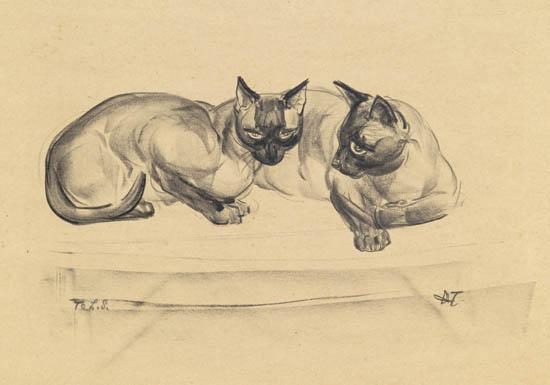
Throughout the 1930s, Tait worked on small lithographic editions and mural work. In 1941 she and her husband relocated to Santa Fe, New Mexico where she remained a resident until her death. While living in Santa Fe, Tait did a number of commissioned portraits and studies of cats.

Agnes Tait
Siamese Cats
c.a. 1925
7 x 12 inches
Oil pastels on cream wove paper 
Private Collection 
 

Agnes focused much of her attention on northern New Mexico, particularly its landscapes, adobes and churches, and various ethnic groups. Her lithographs, watercolors, oils and works in other media included titles such as Lane in Santa Fe; El Christo Rey; Sanctuario de Chimayo; Little Navaho; Pilgrimage to Chimayo; Canyon Coral, and Pecos Valley. [2] She also completed two murals during her time in Santa Fe-one, notably for the Frist National Bank of Santa Fe that depicted the entry of General Stephen Watts Kearny into the city during the Mexican War which she completed in 1953.
 
 
Agnes Tait
Summerstorm
c.a. N.D.
No size given
Oil on canvas
                                                        
Tait exhibited at a number of shows in the east and in the west. Collections of her works are in the New Public Library and Metropolitan Museum of Art in New York, Library of Congress, National Museum of American Art in Washington, D.C., Yale University, Wichita Art Museum, Roswell Museum and Art Center, Museum of New Mexico, and School of American Research, Santa Fe.
Tait was a member and exhibitor in 1936 of the National Association of Women, a seven-time exhibitor at the Art Institute of Chicago between 1915 and 1936, an exhibitor in three annual exhibitions of the Pennsylvania Academy, and in four annual exhibitions of the National Academy of Design.  Other exhibition venues were the New York World's Fair in 1939, Weyhe Gallery, New York City in 1973 and the Los Angeles County Museum of Art in 1976.


Agnes Tait, Adobe church with figures and bonfires
Agnes Tait
Adobe Church with Figures and Bonfires
c.a. N.D.
Lithograph
8 3/4 x 11 3/4 inches
Private Collection

_______________________________________________________________
1. Agnes Tait, Biography, Smithsonian American Art Museum and the Renwick Gallery, http://americanart.si.edu/collections/search/artist/?id=4732, retrieved August 28, 2013.
2. Phil Kovinick and Marian Yoshiki-Kovinick, An Encyclopedia of Women Artists of the American West (Austin: University of Texas Press, 1998), 297.
Other Sources
-Mutual Art, http://www.mutualart.com/Artist/Agnes-Tait/946FA2AAFFD50341/Artworks
-ArtFact, http://www.artfact.com/artist/tait-agnes-eiyev7kwjr
-Patricia Trenton, ed. Independent Spirits: Women Painters of the American West, 1890-1945, (Los Angeles: Autry Museum of Western Heritage in association with the University of California Press, 1995).


Monday, August 12, 2013

Lillian Prest Ferguson: Painter, Potter, Educator

Lillian Prest Ferguson
Still Life
ca. N.D.
Oil on canvas on Masonite
 24 x 19 3/4 inches 
Lillian Prest Ferguson was born in Windsor, Ontario, Canada in 1867, and grew up in Windsor, St. Boniface, and Winnipeg. She attended a convent school where she began some of her formal art training. At sixteen, she received a commission to paint portraits of the parents of St. Boniface school.

Lillian continued to study art in Toronto and later, while teaching at the Winnipeg school of art, she met Peter Ferguson, a lawyer, and they married in 1866. After several months in England, Scotland, and France, where Ferguson studied with Jules Lefebvre at the Academie Julian, the couple immigrated to the United States.

Initially, the Fergusons settled in Riverside, California in 1887. With the advent of the transcontinental railroad in 1869, land speculators, developers, and colonists began to swarm to Southern California where there was plenty of inexpensive, available land. However, opportunities to work as an artist were few, so the Fergusons moved to the city of Los Angeles around 1900.

Lillian Prest Ferguson
Carmel by the Sea
ca. N.D.
Oil on canvas
 20 x 24 inches
While her official "residence" was Los Angeles, she traveled to Europe to study in Holland during the years 1911-1912, spent the summer of 1914 in Carmel at William M. Chase's class, and at the University of Southern California. After her husband's death in 1918, Ferguson spent a decade in Laguna Beach. She was a charter member of the Laguna Beach Art Association and a founder of the group Women Painters of the West. She was an active exhibitor with both groups in addition to participating in shows with the California Art Club, Artists of the Southwest. In northern California she showed at the Berkeley League of Fine Arts, the  California State Fair, Sacramento, and the Santa Cruz Art League.

In addition to painting, the artist was a highly respected potter who operated one of the first kilns in Laguna Beach in 1920. Generally painting from life using oils, pastels, and watercolor, Ferguson also did portraits of the various ethnic groups that lived in southern California. She also enjoyed painting and drawing florals, missions, and landscapes along the coast of California.


All source material from Kovick's An Encyclopedia of Women Artists of the American West.
Photographs from icollector.com, askart.com, and artnet.com